Category Archives: Asana

Yoga Poses to Strengthen Knees

I look forward to answering your questions in this blog.  Please feel free to leave a comment or e-mail your questions to tr***@***********ga.com.

Barbara asks:  What are some knee strengthening exercises and/or exercises to strengthen the muscles around the knees?

This question, like most, has many facets.  Yoga postures can help improve some knee issues.  The trick is figuring out how to do those poses in a way that doesn’t further harm the knee while we’re trying to heal it.  This challenge isn’t unique to yoga.  When I met with a surgeon over 20 years ago to determine whether my own knee condition warranted surgery, he told me that physical therapy exercises for knees had changed, because some of the traditional exercises damaged the “good” knee while rehabbing the injured one.

Therefore, when we work therapeutically with knees, we first must obey the old adage “do no harm.”  This sometimes means adapting poses so that the practitioner doesn’t perform poses in a kneeling position.  Chair adaptations work wonderfully for this.

Then we must make sure that the practitioner uses proper body alignment for her own structure.  Contrary to some yoga philosophies, there is no “right” standard of alignment that can be universally applied.  It must be discovered via observation and experimentation with each individual.

Beyond that, the goal is to make sure the muscles that support the knee joint are balanced: that the hips, quadriceps, hamstrings and calves are flexible and strong in a balanced way.  Simply strengthening one muscle group over another may do more harm than good, especially if we ignore the opposing muscle groups and don’t pay attention to overall flexibility.

That said, below are a couple of my favorite postures for strengthening the quadriceps and hamstrings.  Please be aware, however, that unless I work with a client one-on-one and observe their specific condition, I can’t know for sure what is needed to help this complex and surprisingly fragile joint.  Therefore, proceed with caution and please discontinue these postures if they cause any discomfort in your knee or anywhere else!

Strengthening poses for knees:

Note:  Please remember that Viniyoga is a dynamic practice.  Even though the pictures below show static postures, each should be repeated dynamically, and each repetition should be connected with the breath.

Half Squat Against a Wall: This pose strengthens the quadriceps, hamstrings and hips.  When doing this pose, please stand on a non skid surface.  As you move into the squat, make sure that your knees track over the center of your feet and do not extend beyond your toes.  Also make sure to keep your hips higher than your knees.

Bridge, gently squeezing a blanket or ball between the knees: This pose also strengthens quadriceps and hamstrings, along with other muscles.   As with the squat, do not let your knees go behind your toes.  Squeezing the blanket engages the inner thigh muscles and promotes correct positioning of the feet.  Always keep both edges of the feet and all ten toes on the ground.

Cobra, bending the knees: This back strengthener also promotes mobility in the knee join and builds strength in the hamstrings.  You can either bend one knee at a time or both.  Flexing the foot as you bend the knee and imagining that you are wearing an ankle weight deepens the work.

Thank you for your question, and I hope this helps!

Namaste

Tracy Weber

          A Killer Retreat

Come visit Whole Life Yoga in Seattle, and check out Tracy Weber’s author page for information about the Downward Dog Mysteries series.  A KILLER RETREAT is available for preorder now from Whole Life Yoga. MURDER STRIKES A POSE is available at Amazon, Barnes and Noble,  and book sellers everywhere! 

Can Yoga Reduce Belly Fat? Response to a Student Question

I look forward to answering your questions in this blog.  Please feel free to leave a comment or e-mail your questions to tr***@***********ga.com.

A WLY student asks:  I’ve found that as I age, my abdomen has gotten larger.  It sometimes gets in the way when I do yoga poses.  Any ideas on what to do about this, and can yoga help me reduce the size of my belly?

This question has a number of facets.

First, yoga and weight loss.

Studies have shown that yoga does indeed, help with weight loss.  But its effects can’t be explained via our Western models of exercise.  The actual calories expended during a yoga class are relatively minor compared to, say, exercise biking or jogging.  The yoga teachings say that certain poses have a “Langhana” or reducing effect.  Twists and forward bends are examples.  These would be the kinds of poses we would target for weight loss, not necessarily the ones that burn the most calories.  Likely these poses help improve digestion and reduce stagnation of food and other toxins in the body.  I believe, however, that yoga’s biggest weight loss impact comes from the mindfulness that it creates.  When we are in tune with our bodies and in harmony with our spirits, we tend to eat more appropriately.  For many this results in weight loss.  For me, it actually resulted in a weight gain to a more healthy weight.

Second, yoga and spot conditioning

Body shape is largely determined by fat storage patterns in the body.  This is often genetically determined.  Oh if only there were a magic exercise, any magic exercise, that would get rid of what my family calls the “Weber thighs.”  But even when I weighed less than 100 pounds, I STILL had them–thighs that were out of proportion to the rest of my body.

Men frequently store fat around the middle.  As women age, our fat storage tends to shift from our hips to our bellies, especially after menopause. Fat stores are best decreased via diet and aerobic exercise, but people rarely lose fat in only the target area, hence the crazy popularity of liposuction.  Instead, our goals should be to burn it from the entire body via a combination of right eating, aerobic exercise, and strengthening.

However, occasionally bellies seem larger because the internal organs sort of “pooch out.”  In that case, strengthening the abdominal muscles may help support internal organs and decrease belly size.   Boat pose, yoga crunches, and the toe tapping pose we often do in class are awesome for strengthening the “Girdling” muscles of the body.


Finally, adaptation of yoga for those with a rounder belly (for whatever reason!)

The key here is simply to make room for the breath.  Most yoga poses can be adapted to create that extra space you need.   Whenever you’re doing a pose that causes compression, such as a standing or kneeling forward bend, consider widening your legs or knees.   We often say that the feet should he hips bone distance apart, but really, that is the minimum.  They can always be wider if needed for comfort.  And when you’re in the pose, imagine that you are breathing into your back.  This will help you emphasize expanding the back of the rib cage, which will allow for a deeper breath.  Any time you become breathless or feel that the breath is strained, come out of the pose and go back into it when you’re ready.

But remember, it’s not about what you look like, in yoga or in life.  The primary goal of yoga, regardless of your body type, is to bring you greater health and balance.  The rest is just window dressing!

I hope that helps!

Namaste

Tracy Weber

          A Killer Retreat

Come visit Whole Life Yoga in Seattle, and check out Tracy Weber’s author page for information about the Downward Dog Mysteries series.  A KILLER RETREAT is available for preorder now from Whole Life Yoga. MURDER STRIKES A POSE is available at Amazon, Barnes and Noble,  and book sellers everywhere! 

Developing a Yoga Therapy practice on a Small Island

This week’s blog entry is written by guest author, Marcia Olmsted. Marcia is a graduate of Whole Life Yoga’s teacher training program (200 hour) and has since completed her 500 hour certification with the School of Integrative Yoga Therapy with Joseph and Lillian Lepage and is currently working on her 1000 hour certification with IYT.  Marcia has spent the last three years developing an integrated yoga therapy and personal training practice on Pender Island, near Victoria, British Columbia.  You can reach Marcia at yo******@***il.com

My original career intentions were to work therapeutically with people but I ended up working on team effectiveness in the corporate world for 25 years.  As I became ready to transition to a different way of living, I became certified as a personal trainer to start moving back to my goal of helping people.

While I enjoyed working with individuals on their fitness, the mind-body connection was missing.  I searched for yoga teacher training in Seattle (where I lived at the time) and found what I was looking for – Whole Life Yoga.

Under Tracy Weber’s mentorship, I found the perfect combination of functional yoga training that supported my fitness certification, packaged with yogic options to increase wellness at all levels.

Tracy opened my eyes and my heart to exploring yoga therapy tools for myself as well. A week before I started studying with Tracy, I had a major disc herniation (C6-C7) and was sure I had to cancel my training.  Tracy convinced me instead that I would learn through my own experience how to protect my injury while keeping the rest of me in balance as I healed.  A year later, I was 90% healed with no surgery.

It’s been just over three years since I moved to Pender Island, a thirty minute ferry ride to Victoria, B.C.  I set out deliberately to not set up a business but to do things differently – to contribute to the island ensuring that I would feel a fair exchange of energy.   My therapeutic yoga focus, especially private yoga therapy combined with personal fitness tools distinguished my services on the Island. I set up guiding principles for myself that would support my objective of complementing and partnering with others in the wellness business, where possible. I would charge the going rate ($10 drop in and $60/session for privates – very low in comparison to city rates, I know).  I would do my best not to schedule my classes against other yoga classes on the Island.

Marcia’s yoga studio in the basement of her renovated home on Pender Island, BC

Before our house renovations, I offered small Viniyoga classes in my basement.  There two cement poles around which I carefully positioned mats for visibility.  I began to work privately with people on the island who had various issues – my neighbor who was sadly dying of terminal colon cancer with complications from pulmonary fibrosis.  I did gentle postures with him 3-4 times a week focusing on gentle breath work to relieve the anxiety he increasingly felt as he needed to use his oxygen tank more and more.  A 72 year old woman who was overweight, deconditioned and depressed felt that her active days were over.  We worked together to shape a  combined personal training program (cardio and strength) as well as a series of 15 minute private yoga home practices to increase her fitness but also her sense of self-confidence and control over how she felt.  She continues to come to my ongoing drop in classes and workshops today.

Today I offer 6 yoga classes a week – some drop in, some therapeutic series such as Yoga and Aryuveda and work with people privately on a regular basis.

Yoga for Men 55+ Class at the Anglican Parrish Hall on Pender Island, BC (registrations have remained from 20-25 for every 8-week series for the last 3 years)

I am so grateful for the solid foundation that Tracy and Whole Life Yoga gave me in yoga therapy.  I can still hear Tracy saying that I will go to “yoga jail” when I sometimes put too many backbends together or pay more attention to how I’m feeling instead of to those that I serve.

Where will yoga on the Island go from her for me?  My answer today is simply, I will do the next indicated thing, providing value where I can and continuing on this lifelong path of yoga.

Marcia

Viniyoga: A Practice for All Stages of Life

I’m always happy to get calls from senior students looking to begin a yoga practice for the first time, as well as from parents looking for yoga classes for their children.  Of course, the sooner you start yoga, the better, but yoga is not simply a practice for the fit and the young.  Viniyoga, in particular, is well suited to serving individuals of all ages, fitness levels, and conditions of illness or health.  Since we offer a methodology, or approach, to yoga versus a given posture form, sequence or temperature range, we can teach a variety of clients from the hospitalized and very ill, to teen-aged gymnasts, to everything in between. Krishnamacharya (the founder of this lineage) practiced yoga his entire life, until he was well over 100 years old.  In short, Viniyoga is a practice that can (and should) serve a person throughout their entire life.  The goals and methods of yoga practice should change to meet the specific needs of each stage of life, however.

In youth (the sunrise stage of life), we focus on increasing strength, stamina, and concentration while promoting balanced development of the body and mind.  This typically means stronger, fitness oriented asana (postures) with a stricter focus on form. Of course, even children often benefit from a more therapeutic type of yoga, and in that case we focus on healing practices while still integrating the play and challenge children love.

From about the mid 20’s to mid 70’s (the mid day stage of life), our goal is to stay healthy, active, and to heal from the injuries and illnesses our bodies have picked up along the way.  We therefore decrease our focus on strong asana and increase our focus on developing the breath.  We also use yoga postures therapeutically to overcome injury and illness, and to promote balance in the musculoskeletal, physiological and emotional systems.   Yoga can still help us gain strength and flexibility, but the goal shifts from stronger asana to more breath-centered, adaptive asana.

In our later years (the sunset stage of life), our goals shift yet again.  From the time we enter our late 70’s until we pass on, our goal is to stay as self sufficient, mobile, and healthy as possible.  We use meditative asana and breath work to maintain physiological health and to keep our bodies functional as we age.  We also incorporate more meditation to help us focus the mind and prepare for our next journey to whatever is beyond this life.

No matter what your current age, you can definitely benefit from yoga. You’re never too young or to old.  Age is no excuse for not starting a yoga practice, or not continuing it.  As you change with time, so will your practice.  And in that transformation, you may well find a depth and beauty you never thought possible.

Namaste

Tracy Weber

Come visit Whole Life Yoga in Seattle!

Practicing for Yourself

This week’s blog entry is written by guest author Tiffany Blackburn. Tiffany is a graduate of Whole Life Yoga’s teacher training program.     She  can be contacted at tiffanyblackburn.com.

It took me so long to practice yoga for myself. I went to countless classes over the years, dutifully doing everything the instructor called out. I did every “if you want to work harder…” option that was offered and I never accepted the invitation to “rest if you need to.” I reached higher, sank deeper, stretched further whenever the teacher walked by or glanced my way. I compared myself relentlessly to the stronger, more flexible people on the mats around me, and struggled to keep up. I was practicing to please the instructors and to gain the admiration of my fellow students. I was practicing with the exact opposite of mindfulness — I was practicing mindlessly.

The result was pretty predictable: injury after injury. But I kept at it because I believed the the fault was with my body, with myself for not working hard enough. That was part of the reason I looked into a teacher training. I wanted to learn more about yoga because simply taking classes wasn’t providing me with the answers I wanted, specifically “why wasn’t I doing it right?”

It wasn’t until I researched training programs that I really came to understand the differences in yoga styles. In my quest, I took an introductory series in Viniyoga at Whole Life Yoga. I went in feeling like I already knew a lot about yoga, but Viniyoga was such a different experience that I was blown away. The movements were so careful, and the use of breath brought my practice so much more internal than it had ever been before. The nurturing attitude, the non-competitive atmosphere, the thoughtful instructions all combined to finally allow me to relax on my mat and actually notice what was going on in my body and my mind. I don’t think that there is anything wrong with other styles of yoga, but I do think that my experience with Viniyoga was what it took for me to finally “get it.”

Over time, practicing and attending the 200-hour Viniyoga teacher training, I came to better understand both yoga and myself. I’ve come closer to accepting the fact that we all have limitations, and some things just don’t work for my body. I found that easing up a little has actually allowed me to progress further, and that it doesn’t matter what anyone around me is doing. Now I frequently take the opportunity to rest during practice — even if the teacher is looking.

Tiffany

Come visit Whole Life Yoga in Seattle!

How Often Should I Practice Yoga?

This is a question students often ask me, whether they are trying to improve their physical endurance or help heal from the loss of a loved one.  It’s hard for me to give a definitive answer.  When my teacher is asked that question he answers, without hesitation, “every day.”    But I tend to use Viniyoga’s  standard answer to every question: “It depends.”  It depends on your goals, your lifestyle, and even more importantly how you define yoga practice. 

Let’s start by assuming you define yoga practice as asana, or movement.

In that case, Gary’s answer of “every day”  seems really overwhelming to me.  He equates a daily practice to flossing your  teeth;  something you do  consistently, gently, daily, for overall health.   But to be completely honest, there are days I don’t get around to flossing, either.  (Don’t tell my dentist!)

And I do avoid sharing that information with my dentist.   Because when he asks, I know the answer he wants to hear.  I don’t lie to him, but I always feel guilty, even though the answer is almost every day.  Likewise, if we think the goal of yoga is to practice asana every day, anything less than that feels like a failure.    And if we fail, we are more likely to give up on yoga altogether. 

So I never tell students to practice asana “every day.”   Don’t get me wrong.  I believe strongly in the benefits of a consistent  asana practice.  It can help improve everything from emotional stress  to low back pain.  I’ve found that the “sweet spot” for my clients, however, is usually practicing around three days a week.  More than that is likely a bit better.  Less than that will very often bring results, just not as dramatically or as quickly. 

If you can come to class three times a week, awesome!  Our early morning yoga immersion students can attest to the benefits they receive from practicing at the studio that often.   If you can’t, however,  I recommend one class with a teacher each week.  The other two practices can be shorter (15 to 20 minutes is surprisingly effective) and done at home.   Many of the series we offer, such as Yoga for Healthy Backs and Yoga for Real People offer home practices as part of the series, for that specific reason.

But the above still only addresses the question if you define yoga as a physical practice. In fact, it is so much more than that.   It is a set of tools that encompasses meditation, sound, movement, breath work, and ritual.  Beyond even that, it is a system of living that fosters connection, compassion, and presence.  It’s about cherishing the relationships of your life, and striving to better understand the people within those relationships.  Those are components of yoga I try to practice every day–even on those days the dental floss doesn’t make it out of the bathroom drawer.    It’s not just a daily practice, but hopefully a continual one.

Namaste

Tracy  Weber

Come visit Whole Life Yoga in Seattle!

The Five Levels of Yoga Practice


My yoga teacher often jokes about what he calls the “reductionism of yoga in America.”  Basically, he says that in India, yoga is a system of complete physical, mental and spiritual health.  When yoga was brought to America, however, practitioners latched on to asana, or the physical postures of yoga.  Then as time went on, they focused on the stretching aspects of asana, instead of the full energetic, stretching, balancing, and strengthening effects.  Then, he continues, with the common focus on form, it became about locking the knees and focusing on the hamstrings.  So, he jokes, yoga in America has been reduced to stretching your hamstrings.

Like most jokes, this is likely an oversimplification.  But he has a very valid point.  Look at any article on yoga and you will see people performing postures, as if those postures were the only component of yoga.  In reality, yoga is comprised of many tools, only one of which is asana.

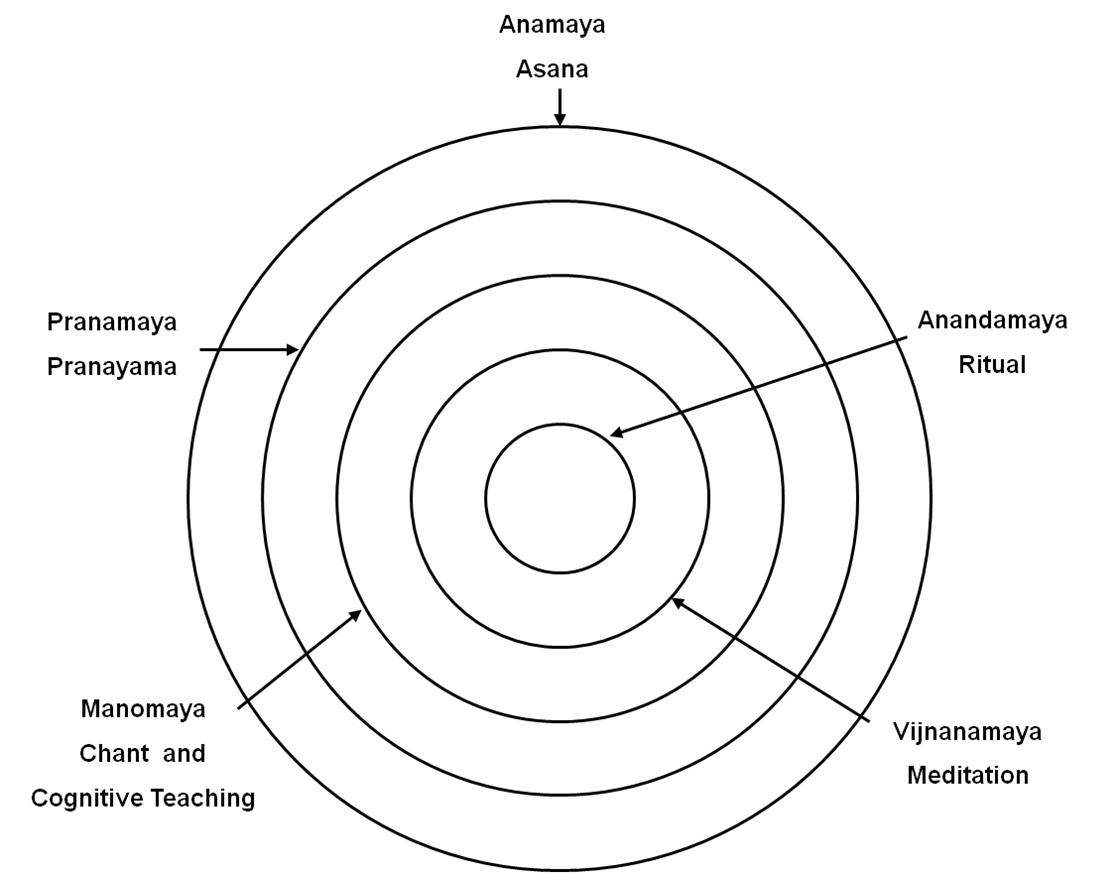
The Pancamaya Model describes the full breadth of yoga practices and how they can impact every level of the human system.  The model progresses from the most gross, or tangible level, to the most subtle, or intangible one.  Work on one level may show up in another, but the tool associated with that level is the one most likely to have direct impact on that level.

The Pancamaya Model

Anamaya:  This level comprises the “food” body, or the muscles, bones, ligaments, etc. of our bodies.  Not surprisingly, the yoga tool we use to impact this level is asana.  So when I teach my yoga for healthy backs class, for example, we primarily focus on yoga movements that can help heal the students’ structural issues.

Pranamaya:  This level comprises the “Energy” body.  It includes physiological systems, such as the respiratory system, as well as the energy of emotions.  The tool most targeted for this level is pranayama or breath work.  That’s why I use the breath practice “Tracy’s sleeping pill” personally and with my clients who have insomnia.  Although asana can help, breath is the more powerful and targeted tool for these issues.

Manomaya:  This level is the level of intellect.  This may be a stretch for some Westerners, but the tool used to increase intellect in the traditional teachings is sound, or chant.  In the West we tend to use reading and lecture. When these models were developed, there were no printing presses, so knowledge was passed down in orally from generation to generation.   In India, however, they still use chant to help improve cognitive function in many populations, including the aging and children with learning issues.

Vijnanamaya: This is the level of personality, or character.   The yoga tool we use to impact character is meditation. I personally believe all meditation techniques are valid, and I will share some simple techniques with you in later blog articles.  But in this lineage we also do self exploratory mediations that help us learn more about ourselves and how we react to the things that happen to and around us.  Meditation is a key part of my yoga classes for anxiety and depression.

Anandamaya:  This is the level of joy or spirit.  It is impacted via ritual.  I have a hard time describing ritual, except that it is a combination of other practices done in a symbolic way.  We use ritual in the West as well.  Think, for example, of weddings, graduations, etc.  At Whole Life I personally use ritual to mark the beginning and end of every class by ringing chimes and saying namaste.  I do this to help connect to my students in a symbolic way.

So, the next time someone asks you about yoga, remember that the postures that come to mind are really only the tip of the iceberg.   This wonderful tradition offers so much more!

Namaste

Tracy Weber

          A Killer Retreat

Come visit Whole Life Yoga in Seattle, and check out Tracy Weber’s author page for information about the Downward Dog Mysteries series.  A KILLER RETREAT is available for preorder now from Whole Life Yoga. MURDER STRIKES A POSE is available at Amazon, Barnes and Noble,  and book sellers everywhere! 


Yoga Poses for Better Posture–Response to a Student Question

I look forward to answering your questions in this blog.  Please feel free to leave a comment or e-mail your questions to tr***@***********ga.com.

A yoga student asks:  “What are the best yoga poses to counter rounded shoulders and slouching?”

This posture issue is all too common in our world with computers, gardening, driving, knitting, and all of those activities that keep us in a forward folded position.   Every person’s structure is different, so I’d need to see your specific body to answer you most fully, but there are a few guidelines I can give.

Most people in America (about 75% according to my teacher, Gary Kraftsow) have excessive kyphosis (or rounding of the upper back.)   Additionally, most of us spend the majority of our time with our arms in front of us typing, holding babies, cooking, etc.  As a result, many people are tight in the front of the torso and weak and overstretched in the upper back.    Therefore postures that strengthen the low and upper back muscles  are very important.   Those that stretch the front of the torso, specifically the shoulders, ribs and hips can also be very helpful.  It’s best to do this, at least in the beginning, with focused, targeted poses and movements versus stronger, more complex ones.

Since in Viniyoga there’s no one “right” way to do a posture, giving you the posture name is less helpful than talking about specific variations that address this.  But let me try to do both.  The photos show Whole Life Yoga students doing the poses and variations I’m talking about.

To strengthen the low back try the following:

  • Cobra:
  • Locust:

Specific variations of the above can also nicely strengthen the muscles between the shoulder blades (the arms are the relevant adaptation in this case, not the legs):

Variations in which you lift one leg and arm at a time are nice for bringing balance to an asymmetrical body and posture:

Warrior 1 is another great posture.  It stretches the front of the body while building some strength in the back.

  • Warrior with “Goal post arms” opens the front of the shoulders and strengthens the muscles between the shoulder blades:
  • Warrior done one arm at a time stretches the front of the ribs as well as a bit of the psoas and quad:
  • A kneeling variation of warrior targets the psoas and quad in a nice way that counteracts the effects of sitting, but can be hard on the knees:

These are the places I would start.  And remember, work with a qualified yoga teacher who can assess your specific body and give you much more targeted advice than this!

Namaste

Tracy Weber

Come visit Whole Life Yoga in Seattle!

Yoga for Men

This week’s blog entry is written by guest author Rene De los Santos.  Rene is a graduate of Whole Life Yoga’s teacher training program and a teacher at Whole Life Yoga.    He teaches yoga for men as well as mixed gender classes.   He  can be contacted at th*********@***oo.com.

There’s an old saying that we do not choose yoga; that yoga chooses us… perhaps from a previous life?

I first became curious about yoga in 2001 after observing yoga participants leave a class more tranquil and at ease than when I observed them going in. My first thought about yoga was “Someday I’ll do yoga- when I am old”.  But yoga had called me and I quite couldn’t get that ringing out of my ear. My second thought about yoga was that I would only take classes for my own benefit but not teach it.

My misconceptions about yoga were mostly that it was for women and those either really flexible or really weird; rarely did I notice men leading a yoga class but when I did, and got to know them better, I realized that they were not particularly flexible and not at all weird. They were just like me. Normal.

This yoga journey lead me to teacher training at Whole Life Yoga, various workshops in Portland OR, San Francisco CA, Long Island NY and India to study (briefly) with TKV Desikachar, son and student of T Krishnamacharya and his son Kausthub Desikachar. Traveling to India was a life changing experience that continues to this day. It was a revelation to see that the senior teachers at the Krishnamacharya Yoga Mandiram were equally divided between men and women and that a great deal of respect was shown to each.

In India I learned that those who learn about yoga but do not share its teachings are like thieves.

My experience has shown me that most men (not ALL men) in our society have misconceptions concerning yoga; most of the men that I’ve spoken to do think yoga is for women, men with special powers or weird people. Most men new to yoga feel awkward walking into a room filled with women on the floor who they presume to be fit and flexible. Men tend to feel out of their league

Female yoga instructors can help ease the anxiety with new male students by not only welcoming them but also by asking if they have any questions or special concerns. Show them where everything is in the studio even if they are there with a friend who is a regular student.

When my women friends ask me how they can get their man into a yoga class, my response is simple: “Work on your own practice.” I believe strongly that yoga is ultimately about relationships- it ultimately transforms the practitioner, usually and hopefully for the better.

Yoga classes specifically for men only are gaining popularity. It gives men a chance to come together in a non-competitive environment and there’s something special about “man time” (sometimes knows as “me” time).

Men new to yoga tend to like “stronger” postures because of their natural strength; left to their own devices, my guess is that they would work more towards strength and less towards flexibility while women usually do the opposite! This can present a challenge for instructors wanting to create a challenging class with both men and women practicing together.

When my men friends ask me why I “do” yoga, my response is simple: “It makes me a better man.” The journey continues…

Namaste

Rene De los Santos

Come visit Whole Life Yoga in Seattle!

Viniyoga Books and Videos to Motivate your August Practice!

August is the month yoga teachers nationwide wonder where all the students have gone. With long days, warm weather, and summer vacations beckoning, it may be hard to motivate yourself to go to the studio for your regular yoga practice.

But not every practice has to be at a studio! I firmly believe there’s no substitute for an instructor who can personally give feedback on form, design a sequence for your goals, and teach you the basics of a safe and effective yoga practice. But what’s a yogi to do when she just can’t get herself to the studio?

I often work privately with students to develop a written practice they can do at home that is specifically catered to their needs. But that’s a subject for a future blog. 😉

The next best thing is a well conceived and safe book or video. While there are thousands of yoga books and videos out there, until recently there were no videos I felt comfortable recommending. Viniyoga relies so heavily on adapting to the person before us, that we have resisted creating videos that, by their very nature, are ”one size fits all.”

But recently some Viniyoga teachers have taken the challenge, and I’m happy to say that the resources below are quite good. All but the book are available at Whole Life Yoga, in addition to many online retailers.

Yoga for Your Life

This book was written by Martin and Margaret Pierce, with whom I studied prenatal yoga. It has always been my “go to” resource for people who want to practice at home, but don’t know which postures to do or the order in which to do them. With gorgeous photos and a series of practices that build over time, you just can’t beat it for finding or re-invigorating a yoga practice. The last half of the book has practices for different activities, including a yummy pajama-clad practice for bedtime. Unfortunately, Yoga for Your Life is out of print, but there are currently copies available at many online booksellers.

The YogaAway Video Series

This video series was developed by a friend of mine, Bija Bennet, with input from our teacher, Gary Kraftsow. The videos were originally designed for the Hyatt hotels as in-suite video practices for Hyatt guests. There are currently four videos available, with practices focusing on everything from working out to falling asleep. All four have gotten great reviews from my students.

The Viniyoga Therapy Series

These videos were developed by my teacher, Gary Kraftsow. They are a little different than the yoga videos you normally find. Each contains almost 3 hours of material, including several practices, lectures on back pain, and individual tutorials for specific postures. He currently has one for lower back issues and another for upper backs. Two more videos are in the works: one for anxiety and one for depression. I’ll let you know when they are available.

Although there’s no substitute for seeing your bright shining faces at the studio, I hope you will use these resources to continue your practice even when you can’t make it to Whole Life Yoga. And I look forward to seeing you back this fall!

Namaste

Tracy Weber

Come visit Whole Life Yoga in Seattle!