Category Archives: Breath

Viniyoga: A Practice for All Stages of Life

I’m always happy to get calls from senior students looking to begin a yoga practice for the first time, as well as from parents looking for yoga classes for their children.  Of course, the sooner you start yoga, the better, but yoga is not simply a practice for the fit and the young.  Viniyoga, in particular, is well suited to serving individuals of all ages, fitness levels, and conditions of illness or health.  Since we offer a methodology, or approach, to yoga versus a given posture form, sequence or temperature range, we can teach a variety of clients from the hospitalized and very ill, to teen-aged gymnasts, to everything in between. Krishnamacharya (the founder of this lineage) practiced yoga his entire life, until he was well over 100 years old.  In short, Viniyoga is a practice that can (and should) serve a person throughout their entire life.  The goals and methods of yoga practice should change to meet the specific needs of each stage of life, however.

In youth (the sunrise stage of life), we focus on increasing strength, stamina, and concentration while promoting balanced development of the body and mind.  This typically means stronger, fitness oriented asana (postures) with a stricter focus on form. Of course, even children often benefit from a more therapeutic type of yoga, and in that case we focus on healing practices while still integrating the play and challenge children love.

From about the mid 20’s to mid 70’s (the mid day stage of life), our goal is to stay healthy, active, and to heal from the injuries and illnesses our bodies have picked up along the way.  We therefore decrease our focus on strong asana and increase our focus on developing the breath.  We also use yoga postures therapeutically to overcome injury and illness, and to promote balance in the musculoskeletal, physiological and emotional systems.   Yoga can still help us gain strength and flexibility, but the goal shifts from stronger asana to more breath-centered, adaptive asana.

In our later years (the sunset stage of life), our goals shift yet again.  From the time we enter our late 70’s until we pass on, our goal is to stay as self sufficient, mobile, and healthy as possible.  We use meditative asana and breath work to maintain physiological health and to keep our bodies functional as we age.  We also incorporate more meditation to help us focus the mind and prepare for our next journey to whatever is beyond this life.

No matter what your current age, you can definitely benefit from yoga. You’re never too young or to old.  Age is no excuse for not starting a yoga practice, or not continuing it.  As you change with time, so will your practice.  And in that transformation, you may well find a depth and beauty you never thought possible.

Namaste

Tracy Weber

Come visit Whole Life Yoga in Seattle!

Practicing for Yourself

This week’s blog entry is written by guest author Tiffany Blackburn. Tiffany is a graduate of Whole Life Yoga’s teacher training program.     She  can be contacted at tiffanyblackburn.com.

It took me so long to practice yoga for myself. I went to countless classes over the years, dutifully doing everything the instructor called out. I did every “if you want to work harder…” option that was offered and I never accepted the invitation to “rest if you need to.” I reached higher, sank deeper, stretched further whenever the teacher walked by or glanced my way. I compared myself relentlessly to the stronger, more flexible people on the mats around me, and struggled to keep up. I was practicing to please the instructors and to gain the admiration of my fellow students. I was practicing with the exact opposite of mindfulness — I was practicing mindlessly.

The result was pretty predictable: injury after injury. But I kept at it because I believed the the fault was with my body, with myself for not working hard enough. That was part of the reason I looked into a teacher training. I wanted to learn more about yoga because simply taking classes wasn’t providing me with the answers I wanted, specifically “why wasn’t I doing it right?”

It wasn’t until I researched training programs that I really came to understand the differences in yoga styles. In my quest, I took an introductory series in Viniyoga at Whole Life Yoga. I went in feeling like I already knew a lot about yoga, but Viniyoga was such a different experience that I was blown away. The movements were so careful, and the use of breath brought my practice so much more internal than it had ever been before. The nurturing attitude, the non-competitive atmosphere, the thoughtful instructions all combined to finally allow me to relax on my mat and actually notice what was going on in my body and my mind. I don’t think that there is anything wrong with other styles of yoga, but I do think that my experience with Viniyoga was what it took for me to finally “get it.”

Over time, practicing and attending the 200-hour Viniyoga teacher training, I came to better understand both yoga and myself. I’ve come closer to accepting the fact that we all have limitations, and some things just don’t work for my body. I found that easing up a little has actually allowed me to progress further, and that it doesn’t matter what anyone around me is doing. Now I frequently take the opportunity to rest during practice — even if the teacher is looking.

Tiffany

Come visit Whole Life Yoga in Seattle!

A Simple Breath Practice: 30 Days to Change Your Life.

When most people think of yoga, the picture that comes to mind is something off the cover of Yoga Journal:  Fit people doing rubber band like postures while still appearing comfortable enough to smile at the camera.  Asanas, or the poses, are the most widely recognized tools of yoga.  But pranayama is actually the tool most of us should be practicing.   The ages of about 25 – mid 70’s are described in yoga teachings as the “midday” years.  During this stage of life, our yoga practices should center on keeping us healthy, balanced and increasing our lifespan.  The tool that helps improve health in this way is pranayama, or breath work.

Pranayama is subtle yet powerful, and generally we say is should be practiced only under the guidance of trained yoga teacher.  But there are some very simple breath practices that can be done safely and effectively on your own.  My teacher says that if you do 5 – 10 minutes of pranayama every day, it will change your life in ways you can’t possibly comprehend.  He then goes on to say, “But you’ll never know, because you’ll never do it.”

Today, I’d like to challenge you to prove him wrong.  Dedicate 10 minutes a day for the next 30 days to the breath practice below.  Keep a journal and notice the effects.  The first 5 people to share their 30 day pranayama stories with me will even get a prize!

Ramping the Breath Up and Down in the Simple Breath Practice

Here’s the practice:

  1. Come to a comfortable seated or lying position.   You can sit in a chair or on the floor, or lie on a firm surface with your knees bent.  All that matters is that you are not “slouched.”  You should be physically comfortable and your spine should be neutral.
  2. Notice how you feel before beginning to practice, in your body and in your breath.   Then notice how you feel in your thoughts and emotions.  Don’t worry if you don’t feel as you think you “should.” Just notice whatever comes to mind and be grateful for the awareness.
  3. Gradually, over 6 breaths, lengthen both your inhale and exhale.  If your lengthened exhale is longer than your lengthened inhale, great.   If your inhale is greater than your exhale, shorten it until both are equal.  The inhale should not be longer than the exhale and at no time should you strain your breath.
  4. Once you reach a lengthened breath, breathe for at least 12 breaths at this lengthened breath.
  5. Once you finish 12 or more complete breaths, take 6 or more breaths to gradually bring your breath back to a natural rhythm.
  6. Notice any changes you feel after this practice, without trying to judge them as “good” or bad.
  7. Note your experience with this practice and what you noticed before and after it in your practice journal. 

I hope to hear from many of you, and that you benefit greatly from this work.

Namaste

Tracy Weber

Come visit Whole Life Yoga in Seattle!
Reducing Stress with Yoga

This week’s blog entry is written by guest author Melanie Reed.  Melanie is a graduate of Whole Life Yoga’s advanced 500 hour teacher training program and a teacher at Whole Life Yoga.    She can be contacted at sa*********@***oo.com.

We become what we pay attention to.

In our modern urban life we find ourselves in many circumstances which we experience as stressful.   As a result, many of us are chronically stressed, living our lives in a state of mild to extreme exhaustion.

During periods of stress, there are three stages of physical responses:

  • An initial fight-or-flight response, mobilizing the body for immediate action.  Nerve impulses direct energy to muscles and organs needed for survival and away from processes not required for immediate survival (such as digestive and reproductive systems).  Think about what is needed to run away from a tiger…
  • In the second stage, after the initial fight-or-flight response dissipates, hormones are released (such as cortisol) which produce energy, help repair damaged cells, and reduce inflammation.  Thus the individual can continue to resist the situation which is causing the stress.
  • During the third stage, as the body becomes exhausted, large amounts of stress hormones continue to be produced.  Symptoms of persistently high levels of cortisol include anxiety, insomnia, high blood pressure, ulcers, immune dysfunction, and depression.

Responses to stress have served us well during our evolution as humans.  Although we rarely need to run away from a tiger, we do encounter situations which cause stress, such as:  driving on the freeway, listening to the voice of the inner critic, feeling powerless in the face of climate change, difficulties in our relationships and on and on.

For most of us, the stress triggers in our lives are not situations where our physical survival is in question; the source of the stress is psychological.  And, here is where Yoga can provide relief from stress.

One of the powerful effects of the concentrated focus on breathing in Viniyoga is it activates the part of the nervous system which supports a sense of relaxation and calm both in the body and mind.    Students may not be aware of this ‘relaxation response’ until they are resting in savasana (the period of rest at the end of a posture practice).  The peaceful effects of a yoga class can sometimes last for days.

Practices such as pranayama (breath practices), Yoga Nidra, and meditation can help us work directly with our energy, emotions, and the mind to ‘re-pattern’ responses to circumstances which habitually trigger stress.  By consciously choosing to focus our mind on the breath, an affirming word(s) or image, or object (e.g. the flame of a candle), we support the process of transforming our habitual patterns of awareness.  Over time, as we replace a focus on negative reactions with contentment, calm, and relaxation – the flow of our thoughts will become more positive and our behavior toward ourselves and others more appropriate.  In other words, the circumstances which trigger the stress will have less effect on us.

Reacting to situations in our daily lives with fear, frustration, and anger can trigger stress and over time, these kinds of reactions will not only have a detrimental effect on our health, but are also not useful – they do not usually lead to the effect we really want.  With the support of yoga practices we are able to turn our attention to positive qualities and as we practice over time, the positive qualities can become dominant. 

To experience this for yourself, try this simple exploration: in a quiet room, sit in a comfortable position and close your eyes.  Bring your focus to your breath, allowing it to slow down.  After several breaths, as you begin to feel internally calm and settled, focus your awareness on an object of your choice, such as a tree (to invoke groundedness), a bear (to invoke strength), the ocean (to invoke a sense contentment and/or going with the flow), an image of your grandmother (to invoke unconditional love) – anything you are drawn to.  Meditate on the object of your choice for several minutes and then, notice how you feel. 

… you become what you pay attention to.

Melanie Reed

Come visit Whole Life Yoga in Seattle!

The Five Levels of Yoga Practice


My yoga teacher often jokes about what he calls the “reductionism of yoga in America.”  Basically, he says that in India, yoga is a system of complete physical, mental and spiritual health.  When yoga was brought to America, however, practitioners latched on to asana, or the physical postures of yoga.  Then as time went on, they focused on the stretching aspects of asana, instead of the full energetic, stretching, balancing, and strengthening effects.  Then, he continues, with the common focus on form, it became about locking the knees and focusing on the hamstrings.  So, he jokes, yoga in America has been reduced to stretching your hamstrings.

Like most jokes, this is likely an oversimplification.  But he has a very valid point.  Look at any article on yoga and you will see people performing postures, as if those postures were the only component of yoga.  In reality, yoga is comprised of many tools, only one of which is asana.

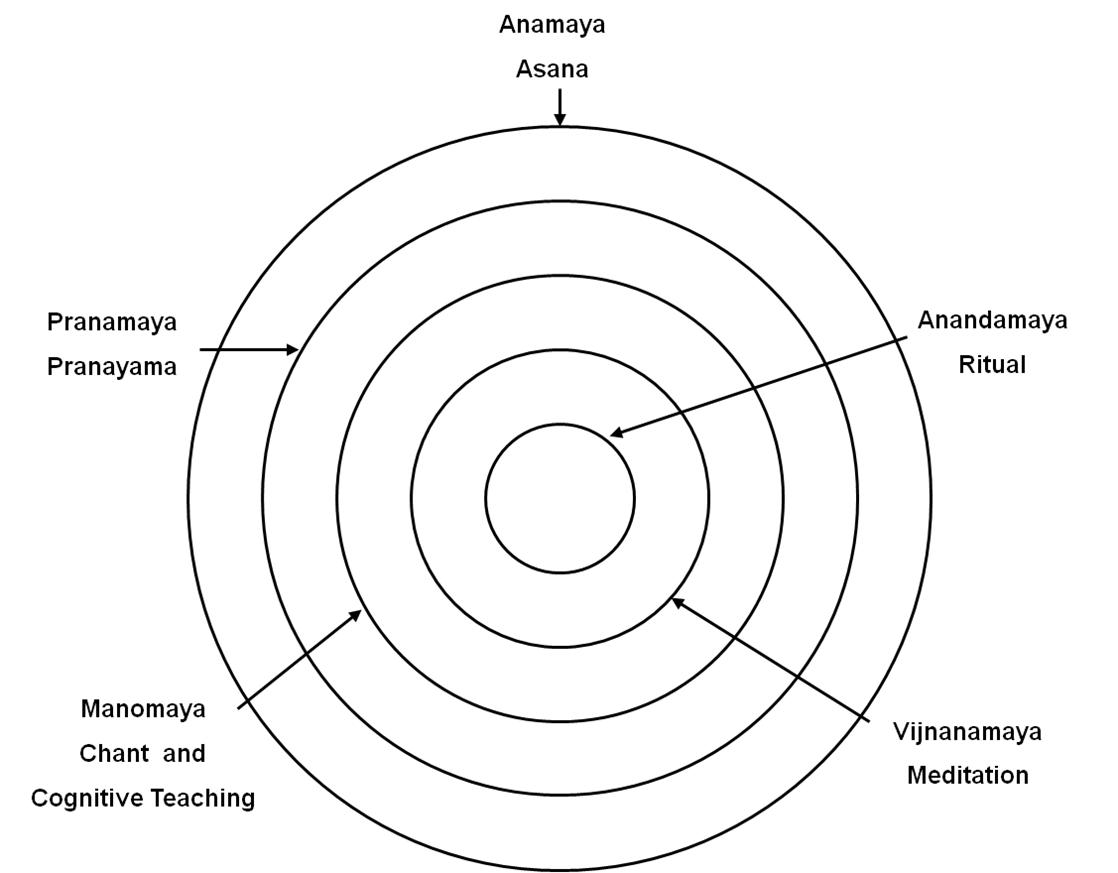
The Pancamaya Model describes the full breadth of yoga practices and how they can impact every level of the human system.  The model progresses from the most gross, or tangible level, to the most subtle, or intangible one.  Work on one level may show up in another, but the tool associated with that level is the one most likely to have direct impact on that level.

The Pancamaya Model

Anamaya:  This level comprises the “food” body, or the muscles, bones, ligaments, etc. of our bodies.  Not surprisingly, the yoga tool we use to impact this level is asana.  So when I teach my yoga for healthy backs class, for example, we primarily focus on yoga movements that can help heal the students’ structural issues.

Pranamaya:  This level comprises the “Energy” body.  It includes physiological systems, such as the respiratory system, as well as the energy of emotions.  The tool most targeted for this level is pranayama or breath work.  That’s why I use the breath practice “Tracy’s sleeping pill” personally and with my clients who have insomnia.  Although asana can help, breath is the more powerful and targeted tool for these issues.

Manomaya:  This level is the level of intellect.  This may be a stretch for some Westerners, but the tool used to increase intellect in the traditional teachings is sound, or chant.  In the West we tend to use reading and lecture. When these models were developed, there were no printing presses, so knowledge was passed down in orally from generation to generation.   In India, however, they still use chant to help improve cognitive function in many populations, including the aging and children with learning issues.

Vijnanamaya: This is the level of personality, or character.   The yoga tool we use to impact character is meditation. I personally believe all meditation techniques are valid, and I will share some simple techniques with you in later blog articles.  But in this lineage we also do self exploratory mediations that help us learn more about ourselves and how we react to the things that happen to and around us.  Meditation is a key part of my yoga classes for anxiety and depression.

Anandamaya:  This is the level of joy or spirit.  It is impacted via ritual.  I have a hard time describing ritual, except that it is a combination of other practices done in a symbolic way.  We use ritual in the West as well.  Think, for example, of weddings, graduations, etc.  At Whole Life I personally use ritual to mark the beginning and end of every class by ringing chimes and saying namaste.  I do this to help connect to my students in a symbolic way.

So, the next time someone asks you about yoga, remember that the postures that come to mind are really only the tip of the iceberg.   This wonderful tradition offers so much more!

Namaste

Tracy Weber

          A Killer Retreat

Come visit Whole Life Yoga in Seattle, and check out Tracy Weber’s author page for information about the Downward Dog Mysteries series.  A KILLER RETREAT is available for preorder now from Whole Life Yoga. MURDER STRIKES A POSE is available at Amazon, Barnes and Noble,  and book sellers everywhere! 


Tracy’s Sleeping Pill: A Practice for Insomnia

It is amazing to me how difficult it is for people to get a good night’s sleep. I personally have suffered from chronic insomnia since I was a teenager, and have been impressed with yoga’s ability to help. Although, when people typically think of yoga they envision postures and movements, some of yoga’s most powerful tools don’t involve movement at all. One such tool is called pranayama, and it works specifically on the energy system in the body.

The word pranayama is derived from the words prana and ayama.

Prana means life force energy, which is a concept we don’t really have in the West. It’s the energy that animates us and gives us life. When we have it, we are alive. When it is gone, we die. It is also the energy of healing, and is very similar to the concept of “Chi” in Chinese medicine. Prana already exists within each of us, but it is mobilized by the breath.

Ayama means to lengthen. So the practice of pranayama is literally the practice of lengthening life force energy by extending the breath.

There are hundreds, if not thousands, of pranayama practices that can be used to get dramatically different effects. I call one of my favorites “Tracy’s Sleeping Pill,” because it is a practice I regularly use to help me fall asleep. It can easily be done lying down in bed, and unlike many sleeping medications there are no unpleasant side effects the next morning.

I’ve given this practice to many clients over the years, and for most, it really makes a difference. So the next time you have trouble sleeping, give this a try. And, if like many of my clients, you never finish it because you fall asleep in the middle of practicing, so much the better!

The Practice:

  1. Lie in bed, on your back in any position that is comfortable.
    Gradually, over 6 or more breaths, lengthen both your inhale and exhale. Make your exhale at least as long as your inhale. Stay at this lengthened breath at least 6 breaths.
  2. Break the exhale portion of your breath into two approximately equal parts, with natural pauses both between the parts and at the end of the exhale. Maintain this breath for at least 6 breath cycles.
  3. After at least 6 breaths, break the exhale portion of your breath into three approximately equal parts, with natural pauses both between the parts and at the end of the exhale.
  4. Continue this breath for at least 12 breath cycles. Do not strain the breath. If you do start to feel strain, go back to the two part breath in step 3. Then continue with that new breath for the rest of the practice.
  5. Once you finish 12 or more complete breaths in step 5, release the pauses completely and breathe with a lengthened breath for at least 6 breaths. Then gradually allow the breath to come back to a normal rhythm.

Namaste, and may you have a great night’s sleep!

Tracy Weber

Come visit Whole Life Yoga in Seattle!

Breath and Movement: A Powerful Union

People new to Viniyoga often tell me they are surprised at the effects of class.  Although class feels gentle while they practice, they often feel “good” muscle soreness the next day.   They are also surprised that although the first class or two may seem easy, the more they practice the more challenging it becomes.  I believe this is completely due to the distinctive way Viniyoga uses the breath.

Viniyoga uses breath in a subtle, yet powerful way.  In asana (movement) practice, we breathe as we do each movement in a way that maximizes the effect of the breath on the spine and the muscles that support it.   Therefore opening, lifting and extending movements are typically done on inhale, whereas bending, compressing and twisting movements are typically done on exhale.

But it’s not as simple as moving with the breath.  Rather, the breath informs, guides and fully surrounds the movement, like a blanket wraps your body on a chilly winter evening.   The breath begins before the movement starts and ends after the movement completes.   This is often called “envelope breathing.”

This integration of breath and movement requires mindful attention and is the key reason viniyoga is so powerful at connecting body, breath and mind.  Only by completely focusing the mind can the movement and breath link together in this elegant dance.  Furthermore, this connection doesn’t stop when the movement ends.  Even when “staying” in a pose, subtle breath focused movement continues.  The student consciously lengthens her spine on inhale and engages and strengthens the muscles of her core on exhale, creating a delicious dance of “micro-movement” that deepens the posture with every successive breath.

So the next time you take a yoga class, pay attention to each breath you take and mindfully allow the breath to guide your movement.   You might be surprised at the profound impact this relatively simple change will have on your practice.

Namaste,

Tracy Weber

Come visit Whole Life Yoga in Seattle!