Category Archives: Meditation

Yoga and Meditation: A Port in the Storm


Last Wednesday was a very tough day in Seattle, and I spent most of the day completely oblivious to it.  As many of you know, several people were killed in a local coffee shop that morning by a mentally ill gunman.  There’s no discounting the tragedy for the victims, the families and friends – even the shooter himself.

But I spent the day working in a different realm: finishing the fourth draft of my novel, which is, ironically, a yoga murder mystery.  I sent the manuscript to my editor just 30 minutes before arriving at the studio to teach.  To say I was in a good mood would have been an understatement.  I sang, danced, and “high fived” myself all the way down Greenwood Ave, ecstatic at having reached this personally huge milestone.

Then I walked into the studio.

The first person I encountered told me about the shootings and the frantic calls she’d received from family and friends.  I responded with something eloquent like “Huh? Did something happen today?”  Soon after, another student told me that her son’s school had spent the day in lock down.  Later, another friend told me how the manhunt had almost expanded to Greenwood – all while I’d been blissfully unaware, creating my own version of mayhem in a wonderfully fictional world.

I have to admit to feeling a little separated from this, even though I myself was the victim of random violence many years ago.  I suspect that’s because I heard about it so much later than everyone else.  Part of me felt guilty for not being as upset as those around me – and part of me didn’t. You see, the yoga teachings never promised us an easy life.  They never promised freedom from suffering.  In fact, they literally say that suffering is inevitable.

What they do promise, however, is a path to peace in spite of it.  They offer us a port in the storm.  No matter how hard we try, we can’t control what happens in this great lottery we call life.  But we can hopefully learn how to be more balanced and peaceful in spite of it.

If you’ve met me, you know that I’m far from perfect.  I stress and angst and worry with the best of them.  But yoga and meditation help.  All we have to do is practice.

I taught the meditation below in my class that night.   May it help you find your own safe harbor in the storms of life.

A Simple Meditation for Inner Peace:

  1. Sit or lie comfortably, with your spine in a neutral position.
  2. Allow your eyes to close and notice your breath – without intentionally trying to change it.  Bring your attention to the warmth and coolness of the breath at the tip of your nostrils.
  3. When you are ready, think of a word that represents inner peace or equanimity to you.  It could be balance, peace, calm, silence, or any other word that has meaning to you.
  4. Each time you exhale, mentally recite that word, and feel inner peace pour through your body, as if it were washing through every cell.  When your attention wanders, just notice it, and invite your attention back to the breath at the tip of your nose.  Then return to reciting your word or phrase with every exhale.
  5. Continue this meditation for 10 minutes or longer if you’d like.

Namaste

Tracy

Come visit Whole Life Yoga in Seattle!

Sitting Pretty—and Comfortably—in Yoga Class

Whenever I see students struggling to sit comfortably in yoga class, I’m reminded of that old Alanis Morissette song—isn’t it ironic that we come to yoga class to decrease pain, then sit uncomfortably on the floor with our backs screaming in agony.

Sitting is notoriously painful for people with back pain; sitting on the floor, crossed legged, without back support, is even worse.  Of course, that’s what most of us tend to do in every yoga class.  There are many better alternatives. A few of my favorites are below.

First, if you do choose to sit cross-legged, look down at your knees.  If your knees are above your hips, then your spine is not in neutral alignment, which will lead to back discomfort.  This problem can easily be fixed by elevating your hips.  Fold a blanket or two and place them under your sitz bones (or ischial tuberosities, for you anatomy geeks.) These are the bony prominences between the tops of your thighs and the bottoms of your hips.  Add blankets until your knees are below your hips, as in the photo below.

For people without knee issues, the sitting posture below is my favorite.  This is how I sit when I teach.  In the first photo, the student is sitting on a block, which elevates her hips to put less pressure on her knees.  In the second, she is sitting on a meditation bench.  My favorite benches are sold at East West Bookshop.  They can be a little pricey, but they last forever.  I’ve had the one in the photo for over 11 years.

We have plenty of blocks and blankets at the studio, and we also have four meditation benches.  So feel free to experiment and find what is most comfortable for you.

Finally, you can always lie down.  There’s nothing magic at all about achieving that perfect lotus pose.  Our goal is to connect the body, breath, and mind. To do that, the spine should be neutral. A neutral spine can be found sitting, kneeling, lying, or standing for that matter. While it’s true that the breath is subtly blocked in a lying position, for most people the effect is minor. If lying gets you out of pain, I say go for it!

Generally, the most neutral supine position lying with the knees bent, feet on the floor, as in the photo below.

The biggest risk in this position is falling asleep.  So try to keep your mind alert, and if you come with a friend, tell them to nudge you if you start snoring!

I look forward to seeing you at the studio soon!

Namaste

Tracy

Come visit Whole Life Yoga in Seattle!

New Viniyoga Videos for Anxiety and Depression

Like many viniyoga teachers, I’m not a huge fan of yoga videos, as the video format doesn’t allow for the customization and adaptation to the individual that is such a hallmark of this rich lineage.  Still, as much as I’d like everyone to experience yoga first hand at Whole Life Yoga or work with me privately, I know that for many students, videos provide a much more convenient and accessible connection to a consistent yoga practice.  Who knows…maybe someday I’ll even create a video of my own!  😉

Until then, two new viniyoga videos have recently been released by my teacher, Gary Kraftsow, on topics that are personally important to me:  Yoga for Anxiety and Yoga for Depression. I’ve suffered from both conditions off and on throughout my life, and yoga has been an incredible powerful tool in helping me manage my symptoms. I may have come to yoga to overcome back pain, but by far the first and most important thing to heal was my heart.

Gary’s new products introduce the viniyoga therapy approach to anxiety and depression.  They are a bit different than typical videos, in that he provides cognitive learning in addition to yoga practice.  Each video contains approximately an hour of lecture on yoga therapy and its applications for anxiety and depression, along with two practices: one that is a bit over thirty minutes and one that is closer to an hour.  Even more unusual, the practices aren’t just asana, or movement.  They contain multiple facets of the rich and dynamic viniyoga lineage:  Asana (movement), Pranayama (breath work), Meditation, and Chanting.

I sell both of these at the studio, along with a few other viniyoga videos.  But they can also be purchased at amazon.com and via other on line sellers.  Of course, I’d much rather see your bright shining faces at the studio, but these videos may provide a nice addition to your collection and to your practice.  Let me know what you think!

Namaste

Tracy Weber

Come visit Whole Life Yoga in Seattle!

Yoga Teachings on Anxiety–A Teacher’s Personal Application

“I have been through some terrible things in my life, some of which actually happened.” Mark Twain

At the risk of annoying some of my readers, today’s blog is personal. As many of you know, I adore my dog. Not the normal, socially acceptable kind of affection most people feel for their pets. Not even the deep love I’ve felt for the dozens of animals I’ve shared my life with in the past. My love for Tasha is inherently, insanely deeper than that. I have found in her a relationship of loyalty and unconditional love that astounds me every day. I’ve never been happier in my life than I have been since the day my husband and I adopted her.

One of the more controversial teachings of yoga is that we should beware of great joy, for buried in the midst of great joy is great suffering. Instead, the teachings say, we should seek peace. In other words, beware of great attachments, because inevitably they come at a price. Although none of us know the future, I have a pretty good idea what the price of loving Tasha will be. After all, her expected lifespan is significantly shorter than mine. Yet still I delude myself, live in the moment, and ignore the future.

When I found a swelling in her breast last Friday, I was concerned but not panicked. When the vet said we should do a biopsy, I was concerned, but not panicked. When the biopsy came back as “inconclusive,” well, that was the final straw. I panicked.

You see, I have a history of anxiety. Yoga helps me keep it under control, but evidently I still have work to do. And we anxiety sufferers know that the nothing feeds our inner demon  more effectively than the unknown.

According to the Yoga Sutras of Patanjali, the purpose of yoga is to decrease the exact sort of suffering I feel now by gaining control over the minds five random activities, or vrttis. Sutras 1.5 – 1.11 outline the mind’s five activities.

  • Correct perception
  • Misperception
  • Memory
  • Imagination
  • Deep dreamless sleep

People who suffer from anxiety are often overwhelmed by three of the above.

  • Misperception. Seeing things not as they are, but “colored” in some way. For me in this moment, I see the word “inconclusive” as evil. In reality, it means we don’t know. It is by definition, neither good nor bad.
  • Memory. Particularly as it relates to similar, unpleasant things that have happened in the past. In this case, I remember my favorite cat. He died on the table during a routine teeth cleaning. No surgical procedure really feels low risk when I remember that.
  • Imagination. Those of us with anxiety are masters at imagining the worst, or as Albert Ellis called it “awfulizing.” The future my crazed mind has come up with would be laughable if it weren’t so real to me.

So how do the teachings help me and others like me? Well first, the sutras are very clear. One activity of the mind predominates most of our psyches: Error. And the teachings of psychology show us that in the absence of information, the mind creates a story that is worse than reality about 90% of the time. So no matter what horror story I create in my mind, I can rest assured that I’m probably wrong, and that whatever I’m imagining is worse than reality. I find comfort in that.

Second, yoga gives us specific practices to combat the hold the mind has over us. I’ve written about two specific practices in prior blogs that are useful in cases of anxiety:

So, I will continue to spend time in my practice, and I hope each of you will as well. Yoga’s biggest gift to us has so little to do with our bodies. Its biggest gift is increased inner peace.

Time for me to practice what I preach.

Namaste.

Tracy

PS–And truly coincidentally, I’m teaching a yoga class for anxiety soon. Check it out at http://www.wholelifeyoga.com/anxiety.html

A follow up several days later.

The yoga teachings were right again.  My mind was in error.  “Inconclusive” may have meant we didn’t know, but now we do.  The follow-up appointment with the vet this morning showed no cancer.  😉 Guess I get to keep my attachment to this lovely beast awhile longer.

A Simple Meditation for Greater Mindfulness and Peace

Meditation is one of my favorite practices, in that it is so simple, yet so incredibly powerful.  When I have a consistent meditation practice I am more mindful, more focused, more calm in the face of challenge.  When I don’t, life is just plain harder.  Meditation doesn’t erase the challenges of life. (And who among us doesn’t have challenges?)  But it makes me less reactive to them and clearer in distinguishing between what is  important and what is not;  What I can control and what I cannot; What is real and what is a crazy trick of my overactive imagination. 

Many students I speak with assert that they “can’t” meditate.  That when they try to meditate, their mind wanders.   Frankly, so does mine.  My chattering mind often sounds like the soundtrack to a bad episode of the Jerry Springer show. 

It doesn’t matter. 

Meditation is not the act of sitting still with a perfectly quiet mind.  Meditation is simply the act of noticing when your mind wanders and inviting it back–again, and again, and again.  The beauty is that every time you notice your mind wander and bring it back, you are learning to control your thoughts instead of letting them control you.  You may not notice the effects while you’re meditating, but I guarantee you’ll notice them in your daily life.  You’ll be calmer, clearer, and likely kinder.  Your loved ones will thank you!

Research shows that as little as 10 minutes a day of meditation 3 times a week yields significant benefits in health and mental well being.     Give it a try and see what happens.   It won’t be easy, but it is simple.  Just breathe, and notice.

Breath Focused Meditation:

  1. Sit comfortably, with your spine erect and the crown of your head floating up to the ceiling.  Sitting either in a chair or on the floor is fine, as long as you are physically comfortable and your spine is in “neutral”. 
  2. Allow your eyes to close or keep your eyes at “half mast” gazing quietly at a place below and in front of you.
  3. Notice your breath—without intentionally trying to change it.  Feel the warmth and coolness of the breath at the tip of your nostrils.  Allow your mind to focus on and pay attention to this feeling of the breath.
  4. If your attention wanders (and it will!) just notice it, and invite your attention back to the sensation of the breath at the tip of your nose.  Try not to criticize yourself.  Instead congratulate yourself for bringing the attention back to the point of focus.
  5. Continue this meditation for 10 minutes or longer if you’d like.

Let me know how it works for you!

Namaste,

Tracy Weber

Come visit Whole Life Yoga in Seattle!

Reflections for a New Year

The transition to each New Year can be a powerful time.    Like many, I spend this time reflecting on the past and creating promises to myself for the future.  These promises have ranged from the dramatic to the absurd.   From larger goals, like changing careers, to physical goals, like losing that dreaded final five pounds, to last year’s seemingly frivolous resolution to spend more time on Facebook

The challenge, of course, is in keeping my annual promises.  I start out determined, but over time my discipline wanes, and with it my commitment.  And I know I’m not alone.  The fleeting nature of New Year’s resolutions is obvious both at the health club I attend and in my own yoga classes.  January 1, the studio is filled with enthusiastic students—many back for the first time since the prior January.   By mid February, the crowds begin to thin. By April we have plenty of room to sweep our arms and do those space-demanding twisting postures.

And the cycle continues, both for many of my students and for me.  Many give up making resolutions all together, deciding it’s simply futile.  Believe me, I’ve been tempted.

But in spite of my own struggle with follow-through, I always try again.  Because I know that the process of setting these goals makes me a better person.    If you don’t believe in New Year’s resolutions, that still shouldn’t stop you.  There’s nothing special about January 1.  Every day is an opportunity to reflect, to commit, and to begin again. By doing so, we plant the seeds of intention that will blossom into future actions.  From intention, from thought, comes everything.

The questions below have been adapted from a meditation I learned when I took my first yoga teacher training.    As we begin 2012, I hope you will join me and incorporate these reflections into your yoga practice and your daily life:

  • What are my most important values?
  • How have my recent actions reflected those values?
  • How have my recent communications reflected those values?
  • How have my recent thoughts reflected those values?
  • How can I change my thoughts, communications, and actions to more closely align with my values in the future?

Each of us has the power, through intention and choice, to live a life that embodies our most important priorities.  We simply need to  use that power.

I hope you have a wonderful 2012. May your new year include not only increased mindfulness, but also great joy.  And I hope to see you at Whole Life Yoga soon—not just in January, but throughout the entire year.

Namaste

Tracy Weber

Come visit Whole Life Yoga in Seattle!

Viniyoga: A Practice for All Stages of Life

I’m always happy to get calls from senior students looking to begin a yoga practice for the first time, as well as from parents looking for yoga classes for their children.  Of course, the sooner you start yoga, the better, but yoga is not simply a practice for the fit and the young.  Viniyoga, in particular, is well suited to serving individuals of all ages, fitness levels, and conditions of illness or health.  Since we offer a methodology, or approach, to yoga versus a given posture form, sequence or temperature range, we can teach a variety of clients from the hospitalized and very ill, to teen-aged gymnasts, to everything in between. Krishnamacharya (the founder of this lineage) practiced yoga his entire life, until he was well over 100 years old.  In short, Viniyoga is a practice that can (and should) serve a person throughout their entire life.  The goals and methods of yoga practice should change to meet the specific needs of each stage of life, however.

In youth (the sunrise stage of life), we focus on increasing strength, stamina, and concentration while promoting balanced development of the body and mind.  This typically means stronger, fitness oriented asana (postures) with a stricter focus on form. Of course, even children often benefit from a more therapeutic type of yoga, and in that case we focus on healing practices while still integrating the play and challenge children love.

From about the mid 20’s to mid 70’s (the mid day stage of life), our goal is to stay healthy, active, and to heal from the injuries and illnesses our bodies have picked up along the way.  We therefore decrease our focus on strong asana and increase our focus on developing the breath.  We also use yoga postures therapeutically to overcome injury and illness, and to promote balance in the musculoskeletal, physiological and emotional systems.   Yoga can still help us gain strength and flexibility, but the goal shifts from stronger asana to more breath-centered, adaptive asana.

In our later years (the sunset stage of life), our goals shift yet again.  From the time we enter our late 70’s until we pass on, our goal is to stay as self sufficient, mobile, and healthy as possible.  We use meditative asana and breath work to maintain physiological health and to keep our bodies functional as we age.  We also incorporate more meditation to help us focus the mind and prepare for our next journey to whatever is beyond this life.

No matter what your current age, you can definitely benefit from yoga. You’re never too young or to old.  Age is no excuse for not starting a yoga practice, or not continuing it.  As you change with time, so will your practice.  And in that transformation, you may well find a depth and beauty you never thought possible.

Namaste

Tracy Weber

Come visit Whole Life Yoga in Seattle!

Reducing Stress with Yoga

This week’s blog entry is written by guest author Melanie Reed.  Melanie is a graduate of Whole Life Yoga’s advanced 500 hour teacher training program and a teacher at Whole Life Yoga.    She can be contacted at sa*********@***oo.com.

We become what we pay attention to.

In our modern urban life we find ourselves in many circumstances which we experience as stressful.   As a result, many of us are chronically stressed, living our lives in a state of mild to extreme exhaustion.

During periods of stress, there are three stages of physical responses:

  • An initial fight-or-flight response, mobilizing the body for immediate action.  Nerve impulses direct energy to muscles and organs needed for survival and away from processes not required for immediate survival (such as digestive and reproductive systems).  Think about what is needed to run away from a tiger…
  • In the second stage, after the initial fight-or-flight response dissipates, hormones are released (such as cortisol) which produce energy, help repair damaged cells, and reduce inflammation.  Thus the individual can continue to resist the situation which is causing the stress.
  • During the third stage, as the body becomes exhausted, large amounts of stress hormones continue to be produced.  Symptoms of persistently high levels of cortisol include anxiety, insomnia, high blood pressure, ulcers, immune dysfunction, and depression.

Responses to stress have served us well during our evolution as humans.  Although we rarely need to run away from a tiger, we do encounter situations which cause stress, such as:  driving on the freeway, listening to the voice of the inner critic, feeling powerless in the face of climate change, difficulties in our relationships and on and on.

For most of us, the stress triggers in our lives are not situations where our physical survival is in question; the source of the stress is psychological.  And, here is where Yoga can provide relief from stress.

One of the powerful effects of the concentrated focus on breathing in Viniyoga is it activates the part of the nervous system which supports a sense of relaxation and calm both in the body and mind.    Students may not be aware of this ‘relaxation response’ until they are resting in savasana (the period of rest at the end of a posture practice).  The peaceful effects of a yoga class can sometimes last for days.

Practices such as pranayama (breath practices), Yoga Nidra, and meditation can help us work directly with our energy, emotions, and the mind to ‘re-pattern’ responses to circumstances which habitually trigger stress.  By consciously choosing to focus our mind on the breath, an affirming word(s) or image, or object (e.g. the flame of a candle), we support the process of transforming our habitual patterns of awareness.  Over time, as we replace a focus on negative reactions with contentment, calm, and relaxation – the flow of our thoughts will become more positive and our behavior toward ourselves and others more appropriate.  In other words, the circumstances which trigger the stress will have less effect on us.

Reacting to situations in our daily lives with fear, frustration, and anger can trigger stress and over time, these kinds of reactions will not only have a detrimental effect on our health, but are also not useful – they do not usually lead to the effect we really want.  With the support of yoga practices we are able to turn our attention to positive qualities and as we practice over time, the positive qualities can become dominant. 

To experience this for yourself, try this simple exploration: in a quiet room, sit in a comfortable position and close your eyes.  Bring your focus to your breath, allowing it to slow down.  After several breaths, as you begin to feel internally calm and settled, focus your awareness on an object of your choice, such as a tree (to invoke groundedness), a bear (to invoke strength), the ocean (to invoke a sense contentment and/or going with the flow), an image of your grandmother (to invoke unconditional love) – anything you are drawn to.  Meditate on the object of your choice for several minutes and then, notice how you feel. 

… you become what you pay attention to.

Melanie Reed

Come visit Whole Life Yoga in Seattle!

A Crazy Idea a Decade Later—The Birth of Whole Life Yoga

Whole Life Yoga under construction prior to opening
Whole Life Yoga’s grand opening celebration was October 13, 2001:  10 years ago this week.  Although I taught under the business name “Whole Life Yoga” at various venues before then, I’ll always think of the studio grand opening as Whole Life Yoga’s beginning.

I’ve been reflecting this past week on this beginning, and I’d like to share some of my memories with you.  Hopefully Whole Life’s story will inspire you to take a risk on something you believe in.

Whole Life Yoga was birthed from a meditation practice I did about 2 years after I started practicing yoga.   On New Year’s day, 1999, I attended a class in which the teacher asked us to reflect on what we wanted to create in our lives.  A clear and somewhat surprising answer came back. “A place for healing and growth.”   For some reason I was sure that meant opening a yoga studio.  It seemed like a good idea, so I went home from class and told my husband.

My words were something like: “Guess what!  I’m going to quit Microsoft, learn to teach yoga and open a yoga studio.  You’ll probably have to support us.”  Being the wonderful person he is, he said something like “If that’s what you want.”   Little did he know how much work there was for him in all of this.  😉  Now all I had to do was take a yoga teacher training and figure out how to build a business.   Easy, right?

Fast forward about 18 months.   I’ll never forget the day I sat down with my accountant to set up the business bookkeeping system and review my financial projections.  Business plan laid out, marketing and financial plans in place, I was excited and ready to sign a lease.  She studied my plans for awhile, not saying much.  She then sat back, looked me directly in the eye and said,  “This is a bad idea.  Go back to Microsoft.”

If all you looked at were the numbers, she was right.  We continued to debate the merits of starting this business until I left to use the bathroom.  While I was there, she perused the titles on my bookshelves.  Texts on yoga, meditation, and mindfulness crowded the shelves.  I didn’t own a single book on software development.  When I came back to the office she said “I’ve been looking at your books.   I guess sometimes you just have to do things that don’t make sense.”

So, on we went.  She, convinced I was committing financial suicide.  I, convinced it would all work out in the end.  In some ways, we were both right.

Honestly, those first two years were brutal.   My father, who lived in Montana, suffered  a stroke a few weeks before we opened.  I literally had to plan the studio’s opening sitting by my father’s bedside, trusting that the building owner understood my plans and would turn the cavern in the picture above into my vision of a healing space.

Most people who knew me thought I’d finally gone off the deep end.  A rumor even started that I had developed a brain tumor!  But it always just seemed like the right thing to me.   I wondered, but really never asked, what my family thought.  They were quite religious and I wasn’t at all sure they understood yoga.   At my father’s funeral, the minister told me something my father never told me in life.  That he was proud that I had left the corporate world  behind to open Whole Life, because I’d be spending my time helping people.  If I had any lingering doubts, that erased them.

We opened about 2 weeks after his death to a much smaller group of students than I anticipated.  I’m sure my accountant had to bite her tongue several times over the next two years to keep from saying “I told you so.”  But slowly the trickle of people through the door became a steady stream.  Our offerings grew, as did our student base.  Now, 10 years later, we’re offering more classes than ever.  We’ve served approximately 9000 yogis and trained almost 200 aspiring yoga teachers.  I hope we’ve helped all of them in some way, be it large or small.   I hope I’ve done my father proud.

As for the future, who knows what the next 10 years will bring?  I sure don’t, and in a way I’m glad.  Not knowing where the path of life will take you makes the journey that much more fun.  But I hope that Whole Life Yoga will still be here, standing strong, continuing to serve you all.

Namaste

Tracy Weber

Please join us in celebrating our 10th birthday on October 30th. .Free yoga and birthday cake!   Details at  http://www.wholelifeyoga.com/celebrate.html

The Five Levels of Yoga Practice


My yoga teacher often jokes about what he calls the “reductionism of yoga in America.”  Basically, he says that in India, yoga is a system of complete physical, mental and spiritual health.  When yoga was brought to America, however, practitioners latched on to asana, or the physical postures of yoga.  Then as time went on, they focused on the stretching aspects of asana, instead of the full energetic, stretching, balancing, and strengthening effects.  Then, he continues, with the common focus on form, it became about locking the knees and focusing on the hamstrings.  So, he jokes, yoga in America has been reduced to stretching your hamstrings.

Like most jokes, this is likely an oversimplification.  But he has a very valid point.  Look at any article on yoga and you will see people performing postures, as if those postures were the only component of yoga.  In reality, yoga is comprised of many tools, only one of which is asana.

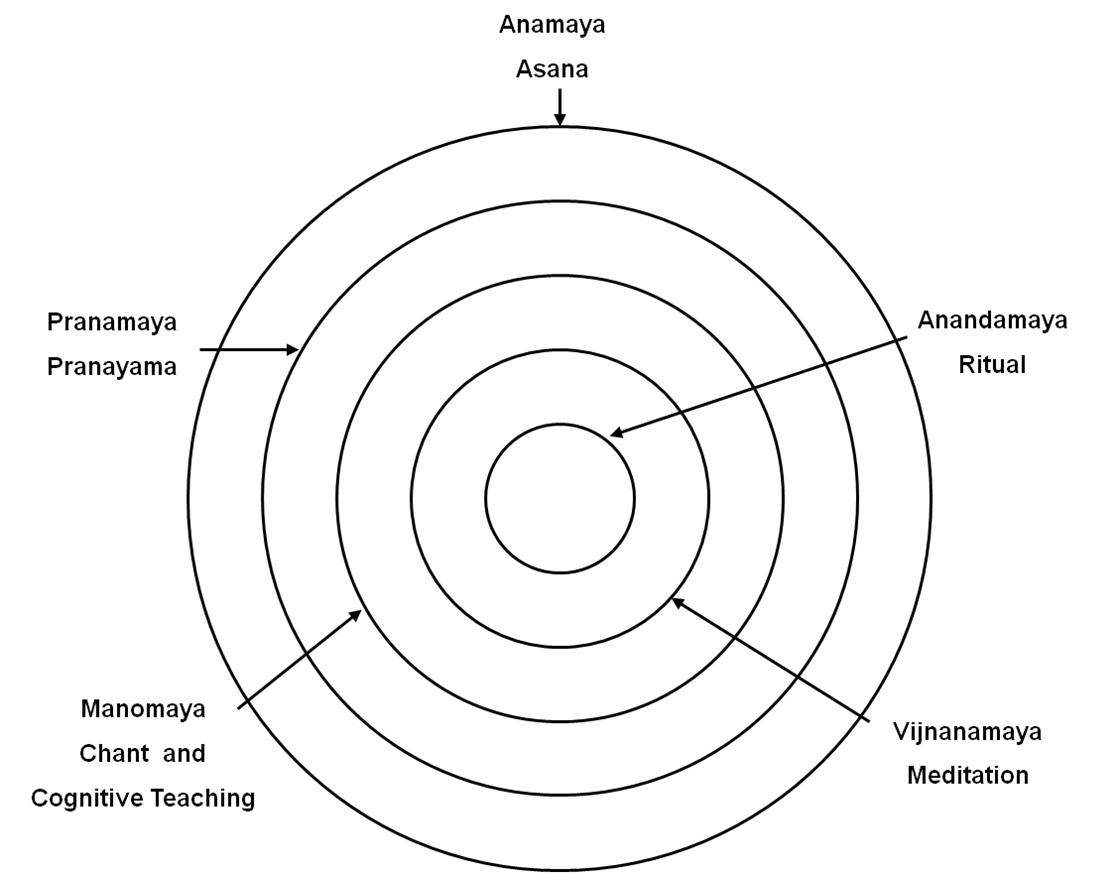
The Pancamaya Model describes the full breadth of yoga practices and how they can impact every level of the human system.  The model progresses from the most gross, or tangible level, to the most subtle, or intangible one.  Work on one level may show up in another, but the tool associated with that level is the one most likely to have direct impact on that level.

The Pancamaya Model

Anamaya:  This level comprises the “food” body, or the muscles, bones, ligaments, etc. of our bodies.  Not surprisingly, the yoga tool we use to impact this level is asana.  So when I teach my yoga for healthy backs class, for example, we primarily focus on yoga movements that can help heal the students’ structural issues.

Pranamaya:  This level comprises the “Energy” body.  It includes physiological systems, such as the respiratory system, as well as the energy of emotions.  The tool most targeted for this level is pranayama or breath work.  That’s why I use the breath practice “Tracy’s sleeping pill” personally and with my clients who have insomnia.  Although asana can help, breath is the more powerful and targeted tool for these issues.

Manomaya:  This level is the level of intellect.  This may be a stretch for some Westerners, but the tool used to increase intellect in the traditional teachings is sound, or chant.  In the West we tend to use reading and lecture. When these models were developed, there were no printing presses, so knowledge was passed down in orally from generation to generation.   In India, however, they still use chant to help improve cognitive function in many populations, including the aging and children with learning issues.

Vijnanamaya: This is the level of personality, or character.   The yoga tool we use to impact character is meditation. I personally believe all meditation techniques are valid, and I will share some simple techniques with you in later blog articles.  But in this lineage we also do self exploratory mediations that help us learn more about ourselves and how we react to the things that happen to and around us.  Meditation is a key part of my yoga classes for anxiety and depression.

Anandamaya:  This is the level of joy or spirit.  It is impacted via ritual.  I have a hard time describing ritual, except that it is a combination of other practices done in a symbolic way.  We use ritual in the West as well.  Think, for example, of weddings, graduations, etc.  At Whole Life I personally use ritual to mark the beginning and end of every class by ringing chimes and saying namaste.  I do this to help connect to my students in a symbolic way.

So, the next time someone asks you about yoga, remember that the postures that come to mind are really only the tip of the iceberg.   This wonderful tradition offers so much more!

Namaste

Tracy Weber

          A Killer Retreat

Come visit Whole Life Yoga in Seattle, and check out Tracy Weber’s author page for information about the Downward Dog Mysteries series.  A KILLER RETREAT is available for preorder now from Whole Life Yoga. MURDER STRIKES A POSE is available at Amazon, Barnes and Noble,  and book sellers everywhere!