Category Archives: Yoga Philosophy

Measuring Progress in a Viniyoga Class—Response to a Student Question

I look forward to answering your questions in this blog.  Please feel free to leave a comment or e-mail your questions to tr***@***********ga.com.

Hayden, a Whole Life Yoga teacher training graduate asks:  A student asked me today how he could measure his progress in my drop-in classes, since they vary so much week to week.  He mentioned, in particular, other yoga classes that always contain sun salutations, and how, if you do them regularly, you can tell that you are getting stronger. But since I don’t want to do regular sun salutations with my class, how can I design drop in classes so that my students are experiencing growth and can see it?  This seems easier to do in a series.

Hi Hayden!  As is usually the case, I don’t have any quick and easy answers to this question.  Gary (my teacher) always says that real progress in yoga practice can best be measured by your relationships.  If your relationships get more stable, your yoga practice is working, and vice–versa.   He also often says that if he were forced to measure the “accomplishments” of his teacher training graduates, he’d evaluate the level of their neuroses.  Remember, according to the sutras, physical prowess was never the intent of yoga practice.  The intent was clarifying and calming the mind.

However….

Viniyoga is multi-faceted.  It can have an orientation that is developmental (Siksana), like my Energize and Strengthen series, therapeutic (Cikitsa), like Yoga for Healthy Backs, or spiritual (Adhyatmika), like my New Years Day workshop.

Physical practice is indeed easier to measure in series classes, as you have the same students over and over again throughout a defined time period. A drop-in practice is trickier, as it’s designed each week based on the students present in class. But drop-in students can still pay attention to how they feel in common poses over time.   There’s absolutely nothing magical about sun salutations.  They are simply a series of specific postures done in a flowing manner. You can measure physical changes in any posture that is taught over and over again.

The trick is to teach the same posture over time and ask students to pay attention to how their body responds to that pose.  For flexibility, seated postures work well. They block escape valves so progress can be more directly seen.  The lateral adaptation of janu sirsansa, deep twists, or regular old pascimatanasana work well for this.  For strength, poses such as plank, caturanga, half squats, arm balances, or all of those lovely prone postures work well.  Progress in those poses would be measured in how many repetitions a student can do or how long they can stay in the pose while maintaining a smooth breath.  For endurance, any flow done repeatedly over time works well.  Breath adaptations in asana and pranayama practices provide effective measurements of breath development.

But the bigger question, I guess, is why is the student practicing?  What do they hope to gain?  And why are they so concerned about measuring themselves? Remember, external measurements are really antithetical to the goals of yoga practice.

Finally, as a teacher, you need to decide who your audience is.  Each class you teach must meet the individual needs of the students present.  This is no easy task–believe me, I know. You may find over time that you need to segment your students into levels, such as beginning, intermediate, and advanced.  Otherwise you won’t be able to adequately meet the needs of anyone.

But above all, please remember, that emotional stability is much more important that any external physical measure.  External measures are more about ego than real growth.

I hope that helps!

Namaste

Tracy

More information about Whole Life Yoga’s teacher training program can be found at our web site:  Yoga Teacher Training at Whole Life Yoga.

Inviting Newness to Your Practice–Lessons from the Tasha-Dog

Gorgeous spring days like today make me feel, well, alive. The air is crisp and infused with the sweet smell of new flowers.  Colors have returned to the Seattle landscape—reds, pinks, purples, blues, greens—even the whites seem to jump out in stark contrast to the gray days we will soon leave behind.
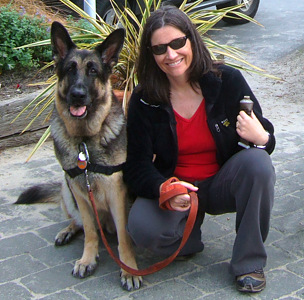
This year, my dog seems unusually entranced by the newness.  Our normal ninety-minute walks stretch to two, even three hours as the paths she found disinteresting all winter suddenly come alive to her again.

Today, as she walked me to her new favorite spot at Greenlake, I was struck by how the familiar is continually interesting to her.  By conservative calculations, we’ve walked Greenlake’s path almost 2000 times in our seven years together; yet she still finds it fascinating.  As she gets older, her interests and abilities change.  She is no longer the great hunter-dog that dragged me, face-down, across the grass as she tried to catch those ever-elusive squirrels.  Now she’s more of an observer, a tour guide of sorts, saying hello to familiar walkers as she gazes across the lake from her new treasured spot in the shade.

But still, every time, she leads us to Greenlake with enthusiasm–with intention.  I never know exactly where we’re headed, but I can tell that she does.  And in spite of her obviously planned destination, she enjoys every minute of the path along the way.

Like Tasha, we can live our lives–and practice our yoga–with great enthusiasm and a sense of newness.  We can bring the same sense of wonder to the 2000th repetition of cat pose that we brought to our first.  As our bodies change, we may not be able to do handstand or wheel, but we can invite vitality, energy, and joy to every pose we can do.  We can invite gratitude and intention to every breath we take.  In fact,  these simple poses give us the opportunity to more fully experience the connection of body, breath and mind that is truly the purpose of yoga.

As we enter this season of re-birth, I’d like to invite all of us, including myself, to experience life and our practice the same way Tasha does.  As happy in exploring the familiar as seeing the new.  As present and joyful in our old age as we were in our youth.   As connected with our world on the days our path is difficult as the day we took our first step.

The yoga sutras call this persevering practice:  Doing the same practice over and over again, over a long period of time, without interruption, with enthusiasm and an intention of growth.  Such a practice, they say, leads to the true goal of yoga: clarity.

May you find newness and re-birth, joy and optimism, hope and clarity this Spring.  And may you experience the inner peace that is the state of yoga.

Namaste

Tracy

Come visit Whole Life Yoga in Seattle!

Yoga, Vegetarianism, and Free Food at Veg Fest!

Whole Life Yoga booth at Vegfest 2004

I became a vegetarian years before I took my first yoga class.  I come from a long line of farmers.  In fact, when my father passed away, he lived in the same house he was born in, which was on the same farm that my great-grandfather started when he immigrated to the United States.  Dad was a dairy farmer; my Uncle Jim raised the beef cattle.  But even though I came from a strong meat-and-potatoes family, I always felt a deep personal connection to animals.  I often said that if I allowed myself to think about it, I wouldn’t be able to eat meat.  In my late 20’s, I thought about it.  😉

People become vegetarian for a variety of reasons: personal health, animal welfare, environmental stewardship, you name it.  For me, it was about compassion.  I just didn’t believe that an animal had to die in order for me to live.

Now where’s the connection to yoga in all of this?

Yogis heatedly debate about yoga and vegetarianism.  Many believe that if you claim to be a yogi, you must also be vegetarian.  Others, of course, disagree.  The word you hear bantered about in these discussions is ahimsa.   According to the Yoga Sutras, yogis must practice ahimsa, or non-harming, in all situations.  For me and people who think like me, ahimsa has to include non-harming to our animal friends.  For others, it’s not that simple.  To be sure, ahimsa has a much broader reach.  We should attempt to act without harm in all situations: to ourselves as well as others, to the planet as well as ourselves.

In all honesty, I don’t have the answer.  My own food choices are judged harshly by others.  I’m vegetarian, not vegan, meaning I eat limited amounts of cheese.  My dog and cats aren’t vegetarian, meaning some animal dies for them to live.  And my husband isn’t vegetarian—but I’m rather fond of him nonetheless.

In the end, each of us lives by our own values.  Whether or not we choose to eat meat, we would all benefit by embodying greater kindness and compassion.  Perhaps even more importantly, we should all learn to live by our own values without judging others for theirs.

Now, on to the free food part of this blog entry.

I’m proud to support Vegetarians of Washington. They promote vegetarianism in a very “ahimsic” way.  They don’t judge, they entice.  As my friend and founder of the organization often says, “we tempt you through your taste buds.”

On March 24 and 25 (this weekend) they are hosting Veg Fest at Seattle Center, and Whole Life Yoga will be there!  Whole Life Yoga teachers and students will be on hand to talk about our classes, answer questions, and give out free passes to students who haven’t tried the studio yet.  And anyone who joins Vegetarians of WA at the festival gets a gift certificate for one free drop-in yoga class!

While you’re there, you can taste hundreds of free samples of delicious, primarily vegan food.  The vegan ice cream alone is worth it!

I hope many of you stop by and see us.  Bring your friends and come hungry.  And take a moment this week to reflect on your definition of ahimsa, regardless of what you eat.

Namaste

Tracy

Come visit Whole Life Yoga in Seattle!

Yoga Teachings on Anxiety–A Teacher’s Personal Application

“I have been through some terrible things in my life, some of which actually happened.” Mark Twain

At the risk of annoying some of my readers, today’s blog is personal. As many of you know, I adore my dog. Not the normal, socially acceptable kind of affection most people feel for their pets. Not even the deep love I’ve felt for the dozens of animals I’ve shared my life with in the past. My love for Tasha is inherently, insanely deeper than that. I have found in her a relationship of loyalty and unconditional love that astounds me every day. I’ve never been happier in my life than I have been since the day my husband and I adopted her.

One of the more controversial teachings of yoga is that we should beware of great joy, for buried in the midst of great joy is great suffering. Instead, the teachings say, we should seek peace. In other words, beware of great attachments, because inevitably they come at a price. Although none of us know the future, I have a pretty good idea what the price of loving Tasha will be. After all, her expected lifespan is significantly shorter than mine. Yet still I delude myself, live in the moment, and ignore the future.

When I found a swelling in her breast last Friday, I was concerned but not panicked. When the vet said we should do a biopsy, I was concerned, but not panicked. When the biopsy came back as “inconclusive,” well, that was the final straw. I panicked.

You see, I have a history of anxiety. Yoga helps me keep it under control, but evidently I still have work to do. And we anxiety sufferers know that the nothing feeds our inner demon  more effectively than the unknown.

According to the Yoga Sutras of Patanjali, the purpose of yoga is to decrease the exact sort of suffering I feel now by gaining control over the minds five random activities, or vrttis. Sutras 1.5 – 1.11 outline the mind’s five activities.

  • Correct perception
  • Misperception
  • Memory
  • Imagination
  • Deep dreamless sleep

People who suffer from anxiety are often overwhelmed by three of the above.

  • Misperception. Seeing things not as they are, but “colored” in some way. For me in this moment, I see the word “inconclusive” as evil. In reality, it means we don’t know. It is by definition, neither good nor bad.
  • Memory. Particularly as it relates to similar, unpleasant things that have happened in the past. In this case, I remember my favorite cat. He died on the table during a routine teeth cleaning. No surgical procedure really feels low risk when I remember that.
  • Imagination. Those of us with anxiety are masters at imagining the worst, or as Albert Ellis called it “awfulizing.” The future my crazed mind has come up with would be laughable if it weren’t so real to me.

So how do the teachings help me and others like me? Well first, the sutras are very clear. One activity of the mind predominates most of our psyches: Error. And the teachings of psychology show us that in the absence of information, the mind creates a story that is worse than reality about 90% of the time. So no matter what horror story I create in my mind, I can rest assured that I’m probably wrong, and that whatever I’m imagining is worse than reality. I find comfort in that.

Second, yoga gives us specific practices to combat the hold the mind has over us. I’ve written about two specific practices in prior blogs that are useful in cases of anxiety:

So, I will continue to spend time in my practice, and I hope each of you will as well. Yoga’s biggest gift to us has so little to do with our bodies. Its biggest gift is increased inner peace.

Time for me to practice what I preach.

Namaste.

Tracy

PS–And truly coincidentally, I’m teaching a yoga class for anxiety soon. Check it out at http://www.wholelifeyoga.com/anxiety.html

A follow up several days later.

The yoga teachings were right again.  My mind was in error.  “Inconclusive” may have meant we didn’t know, but now we do.  The follow-up appointment with the vet this morning showed no cancer.  😉 Guess I get to keep my attachment to this lovely beast awhile longer.

How Often Should I Practice Yoga?

This is a question students often ask me, whether they are trying to improve their physical endurance or help heal from the loss of a loved one.  It’s hard for me to give a definitive answer.  When my teacher is asked that question he answers, without hesitation, “every day.”    But I tend to use Viniyoga’s  standard answer to every question: “It depends.”  It depends on your goals, your lifestyle, and even more importantly how you define yoga practice. 

Let’s start by assuming you define yoga practice as asana, or movement.

In that case, Gary’s answer of “every day”  seems really overwhelming to me.  He equates a daily practice to flossing your  teeth;  something you do  consistently, gently, daily, for overall health.   But to be completely honest, there are days I don’t get around to flossing, either.  (Don’t tell my dentist!)

And I do avoid sharing that information with my dentist.   Because when he asks, I know the answer he wants to hear.  I don’t lie to him, but I always feel guilty, even though the answer is almost every day.  Likewise, if we think the goal of yoga is to practice asana every day, anything less than that feels like a failure.    And if we fail, we are more likely to give up on yoga altogether. 

So I never tell students to practice asana “every day.”   Don’t get me wrong.  I believe strongly in the benefits of a consistent  asana practice.  It can help improve everything from emotional stress  to low back pain.  I’ve found that the “sweet spot” for my clients, however, is usually practicing around three days a week.  More than that is likely a bit better.  Less than that will very often bring results, just not as dramatically or as quickly. 

If you can come to class three times a week, awesome!  Our early morning yoga immersion students can attest to the benefits they receive from practicing at the studio that often.   If you can’t, however,  I recommend one class with a teacher each week.  The other two practices can be shorter (15 to 20 minutes is surprisingly effective) and done at home.   Many of the series we offer, such as Yoga for Healthy Backs and Yoga for Real People offer home practices as part of the series, for that specific reason.

But the above still only addresses the question if you define yoga as a physical practice. In fact, it is so much more than that.   It is a set of tools that encompasses meditation, sound, movement, breath work, and ritual.  Beyond even that, it is a system of living that fosters connection, compassion, and presence.  It’s about cherishing the relationships of your life, and striving to better understand the people within those relationships.  Those are components of yoga I try to practice every day–even on those days the dental floss doesn’t make it out of the bathroom drawer.    It’s not just a daily practice, but hopefully a continual one.

Namaste

Tracy  Weber

Come visit Whole Life Yoga in Seattle!

The Five Levels of Yoga Practice


My yoga teacher often jokes about what he calls the “reductionism of yoga in America.”  Basically, he says that in India, yoga is a system of complete physical, mental and spiritual health.  When yoga was brought to America, however, practitioners latched on to asana, or the physical postures of yoga.  Then as time went on, they focused on the stretching aspects of asana, instead of the full energetic, stretching, balancing, and strengthening effects.  Then, he continues, with the common focus on form, it became about locking the knees and focusing on the hamstrings.  So, he jokes, yoga in America has been reduced to stretching your hamstrings.

Like most jokes, this is likely an oversimplification.  But he has a very valid point.  Look at any article on yoga and you will see people performing postures, as if those postures were the only component of yoga.  In reality, yoga is comprised of many tools, only one of which is asana.

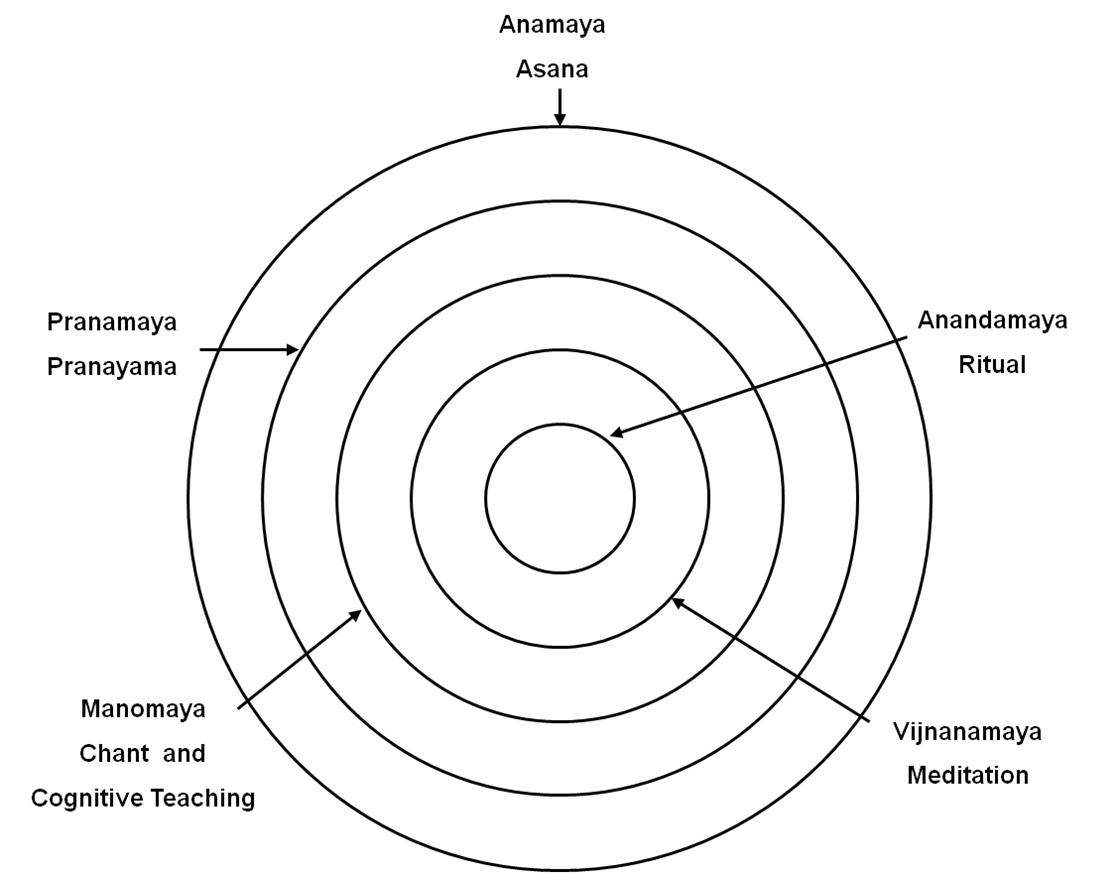
The Pancamaya Model describes the full breadth of yoga practices and how they can impact every level of the human system.  The model progresses from the most gross, or tangible level, to the most subtle, or intangible one.  Work on one level may show up in another, but the tool associated with that level is the one most likely to have direct impact on that level.

The Pancamaya Model

Anamaya:  This level comprises the “food” body, or the muscles, bones, ligaments, etc. of our bodies.  Not surprisingly, the yoga tool we use to impact this level is asana.  So when I teach my yoga for healthy backs class, for example, we primarily focus on yoga movements that can help heal the students’ structural issues.

Pranamaya:  This level comprises the “Energy” body.  It includes physiological systems, such as the respiratory system, as well as the energy of emotions.  The tool most targeted for this level is pranayama or breath work.  That’s why I use the breath practice “Tracy’s sleeping pill” personally and with my clients who have insomnia.  Although asana can help, breath is the more powerful and targeted tool for these issues.

Manomaya:  This level is the level of intellect.  This may be a stretch for some Westerners, but the tool used to increase intellect in the traditional teachings is sound, or chant.  In the West we tend to use reading and lecture. When these models were developed, there were no printing presses, so knowledge was passed down in orally from generation to generation.   In India, however, they still use chant to help improve cognitive function in many populations, including the aging and children with learning issues.

Vijnanamaya: This is the level of personality, or character.   The yoga tool we use to impact character is meditation. I personally believe all meditation techniques are valid, and I will share some simple techniques with you in later blog articles.  But in this lineage we also do self exploratory mediations that help us learn more about ourselves and how we react to the things that happen to and around us.  Meditation is a key part of my yoga classes for anxiety and depression.

Anandamaya:  This is the level of joy or spirit.  It is impacted via ritual.  I have a hard time describing ritual, except that it is a combination of other practices done in a symbolic way.  We use ritual in the West as well.  Think, for example, of weddings, graduations, etc.  At Whole Life I personally use ritual to mark the beginning and end of every class by ringing chimes and saying namaste.  I do this to help connect to my students in a symbolic way.

So, the next time someone asks you about yoga, remember that the postures that come to mind are really only the tip of the iceberg.   This wonderful tradition offers so much more!

Namaste

Tracy Weber

          A Killer Retreat

Come visit Whole Life Yoga in Seattle, and check out Tracy Weber’s author page for information about the Downward Dog Mysteries series.  A KILLER RETREAT is available for preorder now from Whole Life Yoga. MURDER STRIKES A POSE is available at Amazon, Barnes and Noble,  and book sellers everywhere! 


The Philosophy of Yoga

In this week’s post I introduce the key philosophical text of yoga, the Yoga Sutras of Patanjali. In future posts I will delve into more detail about some of the teachings of this wonderful text.

One of my first yoga teachers once said to me “People start taking yoga because of benefits they hope to find in their body. They stay with it because they find something more.”  That quote has always stuck with me, because I’ve found it to be so very true, not just for myself but for many I’ve taught over the years.

People in the West usually think of yoga as strictly a form of exercise. In reality, it is that and so much more! Yoga was originally developed as a method of calming the mind and connecting with the heart. These teachings are wonderfully conveyed in an ancient text called the Yoga Sutras of Patanjali.

Written sometime between 400 BC and 200 AD, this text describes in a compact and almost poetic form the teachings of yoga and how it can help us become more centered, balanced, clear and connected.

The first 2 sutras describe yoga’s purpose: Learning to control the random fluctuations of the mind. They then go on to describe how, in calming those random fluctuations, we can become more connected to our values—to who we truly are at our core—while being less influenced by our filters, projection, fears and anxieties.

This clarity of mind was the undeniable benefit I personally found in practicing yoga, long before I actually studied the sutras. I became clearer about who I am and the mark I want to leave on my world. Things that used to drive me crazy became interesting observations instead of painful traumas. Fears diminished. Courage returned. I’m not perfect by any means, but I’m hopefully getting a bit more balanced every day.

If you’re interested in exploring these teachings further, there are many wonderful translations and commentaries available. My personal favorite is The Essence of Yoga, by Bernard Bouanchaud. It is occasionally difficult to find in the United States, so I have some copies available it at Whole Life Yoga. But if you go to any major bookseller you will find many different translations of the Yoga Sutras of Patanjali on their shelves.

Frugal yogis can also find many wonderful free translations on the internet. Swami J has a translation many of my students have found very useful. But my biggest advice is to be open to changes that happen as you continue your yoga practice. Listen to the voices of truth you may begin to hear. Yoga is not at all about achieving a certain posture.  Release the shackles of thinking that it is all about “stretching” or even “exercise.”  You likely will get stronger, leaner and more flexible. But the most powerful thing you can stretch is your mind!

Namaste,

Tracy Weber

Come visit Whole Life Yoga in Seattle!

The Meaning of Namaste

You often hear it at the end of yoga classes, and I usually sign my blog posts with this word.  But what does it mean, anyway?

Namaste (pronounced Nah-mah-stay) is used as a salutation in India and other countries in the East.   I even heard it spoken in my non yoga travels to Thailand a few years ago.   Namaste is similar, in a way, to “Aloha” in Hawaii.  It has many meanings and uses, including “Hello” and “Goodbye” in verbal communication.  In written communication it is used in a manner similar to how we use “Sincerely.”   In short, it is a considerate way to acknowledge and pay respect to another.

Namaste is a Sanskrit word that has been given many meanings, and I encourage you to find one that works for you and make it your own.  Here are some I’ve heard often…

  • The spirit in me honors the spirit in you.
  • The teacher in me acknowledges the teacher in you.
  • The light in me sees the light in you.

Whenever I say Namaste, however, I am reminded of the derivation of the word, as given to me by my teacher.  If you study the origin of the word and meaning of each syllable, Namaste translates roughly to “Not me, but you.”   This meaning reminds me that every class I teach and every blog I write is not really for me, but for the students in front of me.  It reconnects me to why I teach yoga in the first place:  To create a space of healing and growth for my students.  The other definitions above keep me humble and remind me that each of my students is both my teacher and a source of light in my life.

And if you attend a yoga class and are uncomfortable saying “Namaste?”  Then please feel free to refrain from saying it.   Simply holding a “Thank you” in your heart for your fellow yogis and your practice is perfect!

Namaste,

Tracy Weber

          A Killer Retreat

Come visit Whole Life Yoga in Seattle, and check out Tracy Weber’s author page for information about the Downward Dog Mysteries series.  A KILLER RETREAT is available for preorder now from Whole Life Yoga. MURDER STRIKES A POSE is available at Amazon, Barnes and Noble,  and book sellers everywhere!