Author Archives: Tracy Weber

Viniyoga: A Practice for All Stages of Life

I’m always happy to get calls from senior students looking to begin a yoga practice for the first time, as well as from parents looking for yoga classes for their children.  Of course, the sooner you start yoga, the better, but yoga is not simply a practice for the fit and the young.  Viniyoga, in particular, is well suited to serving individuals of all ages, fitness levels, and conditions of illness or health.  Since we offer a methodology, or approach, to yoga versus a given posture form, sequence or temperature range, we can teach a variety of clients from the hospitalized and very ill, to teen-aged gymnasts, to everything in between. Krishnamacharya (the founder of this lineage) practiced yoga his entire life, until he was well over 100 years old.  In short, Viniyoga is a practice that can (and should) serve a person throughout their entire life.  The goals and methods of yoga practice should change to meet the specific needs of each stage of life, however.

In youth (the sunrise stage of life), we focus on increasing strength, stamina, and concentration while promoting balanced development of the body and mind.  This typically means stronger, fitness oriented asana (postures) with a stricter focus on form. Of course, even children often benefit from a more therapeutic type of yoga, and in that case we focus on healing practices while still integrating the play and challenge children love.

From about the mid 20’s to mid 70’s (the mid day stage of life), our goal is to stay healthy, active, and to heal from the injuries and illnesses our bodies have picked up along the way.  We therefore decrease our focus on strong asana and increase our focus on developing the breath.  We also use yoga postures therapeutically to overcome injury and illness, and to promote balance in the musculoskeletal, physiological and emotional systems.   Yoga can still help us gain strength and flexibility, but the goal shifts from stronger asana to more breath-centered, adaptive asana.

In our later years (the sunset stage of life), our goals shift yet again.  From the time we enter our late 70’s until we pass on, our goal is to stay as self sufficient, mobile, and healthy as possible.  We use meditative asana and breath work to maintain physiological health and to keep our bodies functional as we age.  We also incorporate more meditation to help us focus the mind and prepare for our next journey to whatever is beyond this life.

No matter what your current age, you can definitely benefit from yoga. You’re never too young or to old.  Age is no excuse for not starting a yoga practice, or not continuing it.  As you change with time, so will your practice.  And in that transformation, you may well find a depth and beauty you never thought possible.

Namaste

Tracy Weber

Come visit Whole Life Yoga in Seattle!

Should All Yoga Teachers be Certified? Response to a Student Question

I look forward to answering your questions in this blog.  Please feel free to leave a comment or e-mail your questions to tr***@***********ga.com.

Kristen asks:  Should all yoga teachers be licensed or certified?

This is a loaded question, and one that I feel strongly about.  Currently there is no WA state or US wide regulation of yoga teachers.  Most days I think that’s a very good thing.  Government is good at many things, but understanding yoga isn’t among them.  In New York, they recently tried to pass legislation that would have required licensing and certification of yoga teachers.  That legislation, however, proposed that yoga teachers be certified by the exercise industry, not the yoga industry.   And the exercise industry knows so very little about the true meaning and purpose of yoga.  I honestly believe that, had this law passed, the quality of yoga programs in that state would have suffered.

That said, having no certification or regulation requirements can lead to misuse of the term “yoga teacher.”  There are people all over the country who teach yoga with little or no formal training.  Often times they have a strong personal practice and can do all the poses.  So, they figure, why not teach?  That not only demeans the profession of teaching yoga; it can be dangerous.  Untrained yoga teachers can ask students to do things that are unsafe, may not know how to modify poses for bodies different than their own, or may not fully understand the impact of their teaching all together.  So, if I don’t want licensing, but I DO think proper training is essential, where does that leave us?

The yoga community tackled this question a little over a decade ago.  In 1999 they came together to form an organization called Yoga Alliance.  Yoga Alliance is a voluntary certification body.  It certifies yoga schools that meet certain minimum requirements to train teachers at the 200 hour and 500 hour levels.  Whole Life Yoga’s teacher training program meets these requirements and is a registered Yoga Alliance school.  Therefore every teacher that is certified through our program has been given a minimum of 200 hours of training in 5 key areas:

  • Anatomy and physiology
  • Teaching methodology
  • Yoga techniques
  • Yoga philosophy
  • Teaching practice

As a yoga studio owner, I do require that all of my instructors be certified; not for the certification paper per se, but because the certification demonstrates a level of dedication and training.  In fact, at this time I only hire people who have been certified through my program.  I know their capabilities; I know their ethics; I know their hearts.   I know I can trust them with my business and with the students that make it great.

As a consumer, I would personally only take yoga from someone who is certified or who has taken an equivalent level of training from a reputable school.  Many schools in India don’t certify per se, but they do offer excellent training.  So, as the saying goes, “Let the buyer beware.”  Wherever you take yoga, be sure to ask the instructor where they received their training, how long the training was, and if they are certified.  If they can’t answer or their training was less than 200 hours, then just be aware that they may not have a significant level of education in how to safely and effectively teach yoga.  Whether or not you want to continue taking yoga from them is a completely personal choice.

Namaste

Tracy Weber

Come visit Whole Life Yoga in Seattle!

Practicing for Yourself

This week’s blog entry is written by guest author Tiffany Blackburn. Tiffany is a graduate of Whole Life Yoga’s teacher training program.     She  can be contacted at tiffanyblackburn.com.

It took me so long to practice yoga for myself. I went to countless classes over the years, dutifully doing everything the instructor called out. I did every “if you want to work harder…” option that was offered and I never accepted the invitation to “rest if you need to.” I reached higher, sank deeper, stretched further whenever the teacher walked by or glanced my way. I compared myself relentlessly to the stronger, more flexible people on the mats around me, and struggled to keep up. I was practicing to please the instructors and to gain the admiration of my fellow students. I was practicing with the exact opposite of mindfulness — I was practicing mindlessly.

The result was pretty predictable: injury after injury. But I kept at it because I believed the the fault was with my body, with myself for not working hard enough. That was part of the reason I looked into a teacher training. I wanted to learn more about yoga because simply taking classes wasn’t providing me with the answers I wanted, specifically “why wasn’t I doing it right?”

It wasn’t until I researched training programs that I really came to understand the differences in yoga styles. In my quest, I took an introductory series in Viniyoga at Whole Life Yoga. I went in feeling like I already knew a lot about yoga, but Viniyoga was such a different experience that I was blown away. The movements were so careful, and the use of breath brought my practice so much more internal than it had ever been before. The nurturing attitude, the non-competitive atmosphere, the thoughtful instructions all combined to finally allow me to relax on my mat and actually notice what was going on in my body and my mind. I don’t think that there is anything wrong with other styles of yoga, but I do think that my experience with Viniyoga was what it took for me to finally “get it.”

Over time, practicing and attending the 200-hour Viniyoga teacher training, I came to better understand both yoga and myself. I’ve come closer to accepting the fact that we all have limitations, and some things just don’t work for my body. I found that easing up a little has actually allowed me to progress further, and that it doesn’t matter what anyone around me is doing. Now I frequently take the opportunity to rest during practice — even if the teacher is looking.

Tiffany

Come visit Whole Life Yoga in Seattle!

A Simple Breath Practice: 30 Days to Change Your Life.

When most people think of yoga, the picture that comes to mind is something off the cover of Yoga Journal:  Fit people doing rubber band like postures while still appearing comfortable enough to smile at the camera.  Asanas, or the poses, are the most widely recognized tools of yoga.  But pranayama is actually the tool most of us should be practicing.   The ages of about 25 – mid 70’s are described in yoga teachings as the “midday” years.  During this stage of life, our yoga practices should center on keeping us healthy, balanced and increasing our lifespan.  The tool that helps improve health in this way is pranayama, or breath work.

Pranayama is subtle yet powerful, and generally we say is should be practiced only under the guidance of trained yoga teacher.  But there are some very simple breath practices that can be done safely and effectively on your own.  My teacher says that if you do 5 – 10 minutes of pranayama every day, it will change your life in ways you can’t possibly comprehend.  He then goes on to say, “But you’ll never know, because you’ll never do it.”

Today, I’d like to challenge you to prove him wrong.  Dedicate 10 minutes a day for the next 30 days to the breath practice below.  Keep a journal and notice the effects.  The first 5 people to share their 30 day pranayama stories with me will even get a prize!

Ramping the Breath Up and Down in the Simple Breath Practice

Here’s the practice:

  1. Come to a comfortable seated or lying position.   You can sit in a chair or on the floor, or lie on a firm surface with your knees bent.  All that matters is that you are not “slouched.”  You should be physically comfortable and your spine should be neutral.
  2. Notice how you feel before beginning to practice, in your body and in your breath.   Then notice how you feel in your thoughts and emotions.  Don’t worry if you don’t feel as you think you “should.” Just notice whatever comes to mind and be grateful for the awareness.
  3. Gradually, over 6 breaths, lengthen both your inhale and exhale.  If your lengthened exhale is longer than your lengthened inhale, great.   If your inhale is greater than your exhale, shorten it until both are equal.  The inhale should not be longer than the exhale and at no time should you strain your breath.
  4. Once you reach a lengthened breath, breathe for at least 12 breaths at this lengthened breath.
  5. Once you finish 12 or more complete breaths, take 6 or more breaths to gradually bring your breath back to a natural rhythm.
  6. Notice any changes you feel after this practice, without trying to judge them as “good” or bad.
  7. Note your experience with this practice and what you noticed before and after it in your practice journal. 

I hope to hear from many of you, and that you benefit greatly from this work.

Namaste

Tracy Weber

Come visit Whole Life Yoga in Seattle!

Reducing Stress with Yoga

This week’s blog entry is written by guest author Melanie Reed.  Melanie is a graduate of Whole Life Yoga’s advanced 500 hour teacher training program and a teacher at Whole Life Yoga.    She can be contacted at sa*********@***oo.com.

We become what we pay attention to.

In our modern urban life we find ourselves in many circumstances which we experience as stressful.   As a result, many of us are chronically stressed, living our lives in a state of mild to extreme exhaustion.

During periods of stress, there are three stages of physical responses:

  • An initial fight-or-flight response, mobilizing the body for immediate action.  Nerve impulses direct energy to muscles and organs needed for survival and away from processes not required for immediate survival (such as digestive and reproductive systems).  Think about what is needed to run away from a tiger…
  • In the second stage, after the initial fight-or-flight response dissipates, hormones are released (such as cortisol) which produce energy, help repair damaged cells, and reduce inflammation.  Thus the individual can continue to resist the situation which is causing the stress.
  • During the third stage, as the body becomes exhausted, large amounts of stress hormones continue to be produced.  Symptoms of persistently high levels of cortisol include anxiety, insomnia, high blood pressure, ulcers, immune dysfunction, and depression.

Responses to stress have served us well during our evolution as humans.  Although we rarely need to run away from a tiger, we do encounter situations which cause stress, such as:  driving on the freeway, listening to the voice of the inner critic, feeling powerless in the face of climate change, difficulties in our relationships and on and on.

For most of us, the stress triggers in our lives are not situations where our physical survival is in question; the source of the stress is psychological.  And, here is where Yoga can provide relief from stress.

One of the powerful effects of the concentrated focus on breathing in Viniyoga is it activates the part of the nervous system which supports a sense of relaxation and calm both in the body and mind.    Students may not be aware of this ‘relaxation response’ until they are resting in savasana (the period of rest at the end of a posture practice).  The peaceful effects of a yoga class can sometimes last for days.

Practices such as pranayama (breath practices), Yoga Nidra, and meditation can help us work directly with our energy, emotions, and the mind to ‘re-pattern’ responses to circumstances which habitually trigger stress.  By consciously choosing to focus our mind on the breath, an affirming word(s) or image, or object (e.g. the flame of a candle), we support the process of transforming our habitual patterns of awareness.  Over time, as we replace a focus on negative reactions with contentment, calm, and relaxation – the flow of our thoughts will become more positive and our behavior toward ourselves and others more appropriate.  In other words, the circumstances which trigger the stress will have less effect on us.

Reacting to situations in our daily lives with fear, frustration, and anger can trigger stress and over time, these kinds of reactions will not only have a detrimental effect on our health, but are also not useful – they do not usually lead to the effect we really want.  With the support of yoga practices we are able to turn our attention to positive qualities and as we practice over time, the positive qualities can become dominant. 

To experience this for yourself, try this simple exploration: in a quiet room, sit in a comfortable position and close your eyes.  Bring your focus to your breath, allowing it to slow down.  After several breaths, as you begin to feel internally calm and settled, focus your awareness on an object of your choice, such as a tree (to invoke groundedness), a bear (to invoke strength), the ocean (to invoke a sense contentment and/or going with the flow), an image of your grandmother (to invoke unconditional love) – anything you are drawn to.  Meditate on the object of your choice for several minutes and then, notice how you feel. 

… you become what you pay attention to.

Melanie Reed

Come visit Whole Life Yoga in Seattle!

How Often Should I Practice Yoga?

This is a question students often ask me, whether they are trying to improve their physical endurance or help heal from the loss of a loved one.  It’s hard for me to give a definitive answer.  When my teacher is asked that question he answers, without hesitation, “every day.”    But I tend to use Viniyoga’s  standard answer to every question: “It depends.”  It depends on your goals, your lifestyle, and even more importantly how you define yoga practice. 

Let’s start by assuming you define yoga practice as asana, or movement.

In that case, Gary’s answer of “every day”  seems really overwhelming to me.  He equates a daily practice to flossing your  teeth;  something you do  consistently, gently, daily, for overall health.   But to be completely honest, there are days I don’t get around to flossing, either.  (Don’t tell my dentist!)

And I do avoid sharing that information with my dentist.   Because when he asks, I know the answer he wants to hear.  I don’t lie to him, but I always feel guilty, even though the answer is almost every day.  Likewise, if we think the goal of yoga is to practice asana every day, anything less than that feels like a failure.    And if we fail, we are more likely to give up on yoga altogether. 

So I never tell students to practice asana “every day.”   Don’t get me wrong.  I believe strongly in the benefits of a consistent  asana practice.  It can help improve everything from emotional stress  to low back pain.  I’ve found that the “sweet spot” for my clients, however, is usually practicing around three days a week.  More than that is likely a bit better.  Less than that will very often bring results, just not as dramatically or as quickly. 

If you can come to class three times a week, awesome!  Our early morning yoga immersion students can attest to the benefits they receive from practicing at the studio that often.   If you can’t, however,  I recommend one class with a teacher each week.  The other two practices can be shorter (15 to 20 minutes is surprisingly effective) and done at home.   Many of the series we offer, such as Yoga for Healthy Backs and Yoga for Real People offer home practices as part of the series, for that specific reason.

But the above still only addresses the question if you define yoga as a physical practice. In fact, it is so much more than that.   It is a set of tools that encompasses meditation, sound, movement, breath work, and ritual.  Beyond even that, it is a system of living that fosters connection, compassion, and presence.  It’s about cherishing the relationships of your life, and striving to better understand the people within those relationships.  Those are components of yoga I try to practice every day–even on those days the dental floss doesn’t make it out of the bathroom drawer.    It’s not just a daily practice, but hopefully a continual one.

Namaste

Tracy  Weber

Come visit Whole Life Yoga in Seattle!

A Crazy Idea a Decade Later—The Birth of Whole Life Yoga

Whole Life Yoga under construction prior to opening
Whole Life Yoga’s grand opening celebration was October 13, 2001:  10 years ago this week.  Although I taught under the business name “Whole Life Yoga” at various venues before then, I’ll always think of the studio grand opening as Whole Life Yoga’s beginning.

I’ve been reflecting this past week on this beginning, and I’d like to share some of my memories with you.  Hopefully Whole Life’s story will inspire you to take a risk on something you believe in.

Whole Life Yoga was birthed from a meditation practice I did about 2 years after I started practicing yoga.   On New Year’s day, 1999, I attended a class in which the teacher asked us to reflect on what we wanted to create in our lives.  A clear and somewhat surprising answer came back. “A place for healing and growth.”   For some reason I was sure that meant opening a yoga studio.  It seemed like a good idea, so I went home from class and told my husband.

My words were something like: “Guess what!  I’m going to quit Microsoft, learn to teach yoga and open a yoga studio.  You’ll probably have to support us.”  Being the wonderful person he is, he said something like “If that’s what you want.”   Little did he know how much work there was for him in all of this.  😉  Now all I had to do was take a yoga teacher training and figure out how to build a business.   Easy, right?

Fast forward about 18 months.   I’ll never forget the day I sat down with my accountant to set up the business bookkeeping system and review my financial projections.  Business plan laid out, marketing and financial plans in place, I was excited and ready to sign a lease.  She studied my plans for awhile, not saying much.  She then sat back, looked me directly in the eye and said,  “This is a bad idea.  Go back to Microsoft.”

If all you looked at were the numbers, she was right.  We continued to debate the merits of starting this business until I left to use the bathroom.  While I was there, she perused the titles on my bookshelves.  Texts on yoga, meditation, and mindfulness crowded the shelves.  I didn’t own a single book on software development.  When I came back to the office she said “I’ve been looking at your books.   I guess sometimes you just have to do things that don’t make sense.”

So, on we went.  She, convinced I was committing financial suicide.  I, convinced it would all work out in the end.  In some ways, we were both right.

Honestly, those first two years were brutal.   My father, who lived in Montana, suffered  a stroke a few weeks before we opened.  I literally had to plan the studio’s opening sitting by my father’s bedside, trusting that the building owner understood my plans and would turn the cavern in the picture above into my vision of a healing space.

Most people who knew me thought I’d finally gone off the deep end.  A rumor even started that I had developed a brain tumor!  But it always just seemed like the right thing to me.   I wondered, but really never asked, what my family thought.  They were quite religious and I wasn’t at all sure they understood yoga.   At my father’s funeral, the minister told me something my father never told me in life.  That he was proud that I had left the corporate world  behind to open Whole Life, because I’d be spending my time helping people.  If I had any lingering doubts, that erased them.

We opened about 2 weeks after his death to a much smaller group of students than I anticipated.  I’m sure my accountant had to bite her tongue several times over the next two years to keep from saying “I told you so.”  But slowly the trickle of people through the door became a steady stream.  Our offerings grew, as did our student base.  Now, 10 years later, we’re offering more classes than ever.  We’ve served approximately 9000 yogis and trained almost 200 aspiring yoga teachers.  I hope we’ve helped all of them in some way, be it large or small.   I hope I’ve done my father proud.

As for the future, who knows what the next 10 years will bring?  I sure don’t, and in a way I’m glad.  Not knowing where the path of life will take you makes the journey that much more fun.  But I hope that Whole Life Yoga will still be here, standing strong, continuing to serve you all.

Namaste

Tracy Weber

Please join us in celebrating our 10th birthday on October 30th. .Free yoga and birthday cake!   Details at  http://www.wholelifeyoga.com/celebrate.html

A Yoga Picnic

This week’s blog entry is written by guest author Leo Dunbar. Leo is a graduate of Whole Life Yoga’s teacher training program  and the founder of YogaVan.      He  can be contacted at in**@*****an.com.

Have you ever been on a yoga picnic?  You pack a light meal, grab your yoga mat and blanket, then you head to a nearby Seattle park to practice yoga before enjoying a light lunch or dinner.  “…Yoga outside?  You’ve got to be kidding.  …Maybe a picnic – but not yoga.  And besides, it’s too cold for a picnic; summer is over, or haven’t you noticed.  What are you thinking?”   That’s the conversation that ran through my mind when I first thought of having a yoga picnic, but a yoga picnic is my way of saying good-bye to summer and hello, to fall.

I’m sad to have to say good-bye to the warm sunny days of summer, especially when there seemed to be so few of them this year, but some of our most beautiful days may still be ahead of us.  Call me an optimist, but Seattle has had some exquisite October and November weather in the past.

By the way, you can’t plan a yoga picnic in Seattle, due to our weather, so you just have to be ready to head out the door when you see that little spark of sunshine peak out from behind the cloud.  You know the cloud I’m talking about; it’s the one that seems to sit over us for the next eight months or so.  Sure it travels around a bit during the week days, but it always finds its way back here during our weekends off.

I know the temperatures are a little cooler, and the days are starting to get progressively and noticeably shorter.  Looking around me, I see that some of us seem as reluctant as I am to let the days of summer go.  Some people are still wearing shorts, but they’ve started to pull on their sweaters; socks are being worn with sandals; and soon, the hats we wore to keep the sun out of our eyes will be replaced by the hats that keep our heads warm.  All are signs that summer is over, but that doesn’t mean that all of our outdoor activities have to end.

Go on a yoga picnic.  Bring closure to your loss of Seattle’s summer sun, and give a warm welcome to the blazing new colors of fall.

Leo

Come visit Whole Life Yoga in Seattle!

The Five Levels of Yoga Practice


My yoga teacher often jokes about what he calls the “reductionism of yoga in America.”  Basically, he says that in India, yoga is a system of complete physical, mental and spiritual health.  When yoga was brought to America, however, practitioners latched on to asana, or the physical postures of yoga.  Then as time went on, they focused on the stretching aspects of asana, instead of the full energetic, stretching, balancing, and strengthening effects.  Then, he continues, with the common focus on form, it became about locking the knees and focusing on the hamstrings.  So, he jokes, yoga in America has been reduced to stretching your hamstrings.

Like most jokes, this is likely an oversimplification.  But he has a very valid point.  Look at any article on yoga and you will see people performing postures, as if those postures were the only component of yoga.  In reality, yoga is comprised of many tools, only one of which is asana.

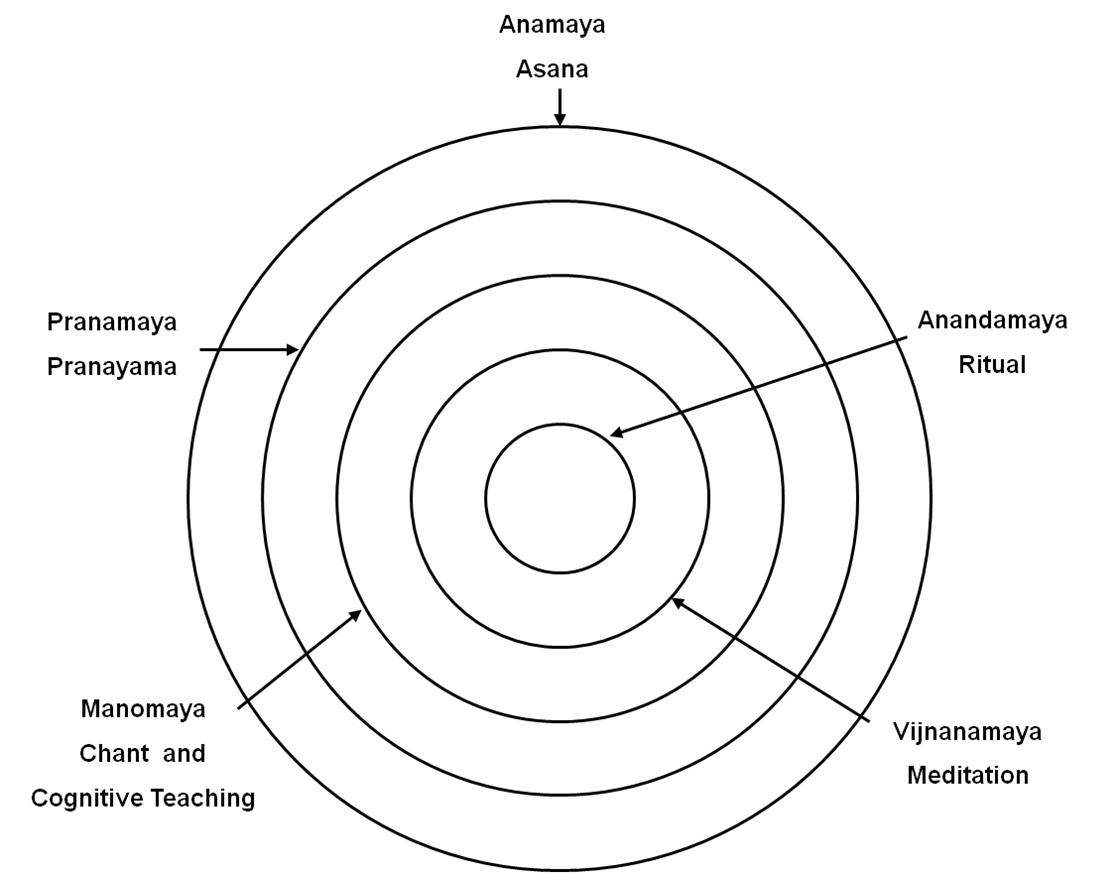
The Pancamaya Model describes the full breadth of yoga practices and how they can impact every level of the human system.  The model progresses from the most gross, or tangible level, to the most subtle, or intangible one.  Work on one level may show up in another, but the tool associated with that level is the one most likely to have direct impact on that level.

The Pancamaya Model

Anamaya:  This level comprises the “food” body, or the muscles, bones, ligaments, etc. of our bodies.  Not surprisingly, the yoga tool we use to impact this level is asana.  So when I teach my yoga for healthy backs class, for example, we primarily focus on yoga movements that can help heal the students’ structural issues.

Pranamaya:  This level comprises the “Energy” body.  It includes physiological systems, such as the respiratory system, as well as the energy of emotions.  The tool most targeted for this level is pranayama or breath work.  That’s why I use the breath practice “Tracy’s sleeping pill” personally and with my clients who have insomnia.  Although asana can help, breath is the more powerful and targeted tool for these issues.

Manomaya:  This level is the level of intellect.  This may be a stretch for some Westerners, but the tool used to increase intellect in the traditional teachings is sound, or chant.  In the West we tend to use reading and lecture. When these models were developed, there were no printing presses, so knowledge was passed down in orally from generation to generation.   In India, however, they still use chant to help improve cognitive function in many populations, including the aging and children with learning issues.

Vijnanamaya: This is the level of personality, or character.   The yoga tool we use to impact character is meditation. I personally believe all meditation techniques are valid, and I will share some simple techniques with you in later blog articles.  But in this lineage we also do self exploratory mediations that help us learn more about ourselves and how we react to the things that happen to and around us.  Meditation is a key part of my yoga classes for anxiety and depression.

Anandamaya:  This is the level of joy or spirit.  It is impacted via ritual.  I have a hard time describing ritual, except that it is a combination of other practices done in a symbolic way.  We use ritual in the West as well.  Think, for example, of weddings, graduations, etc.  At Whole Life I personally use ritual to mark the beginning and end of every class by ringing chimes and saying namaste.  I do this to help connect to my students in a symbolic way.

So, the next time someone asks you about yoga, remember that the postures that come to mind are really only the tip of the iceberg.   This wonderful tradition offers so much more!

Namaste

Tracy Weber

          A Killer Retreat

Come visit Whole Life Yoga in Seattle, and check out Tracy Weber’s author page for information about the Downward Dog Mysteries series.  A KILLER RETREAT is available for preorder now from Whole Life Yoga. MURDER STRIKES A POSE is available at Amazon, Barnes and Noble,  and book sellers everywhere! 


Yoga Poses for Better Posture–Response to a Student Question

I look forward to answering your questions in this blog.  Please feel free to leave a comment or e-mail your questions to tr***@***********ga.com.

A yoga student asks:  “What are the best yoga poses to counter rounded shoulders and slouching?”

This posture issue is all too common in our world with computers, gardening, driving, knitting, and all of those activities that keep us in a forward folded position.   Every person’s structure is different, so I’d need to see your specific body to answer you most fully, but there are a few guidelines I can give.

Most people in America (about 75% according to my teacher, Gary Kraftsow) have excessive kyphosis (or rounding of the upper back.)   Additionally, most of us spend the majority of our time with our arms in front of us typing, holding babies, cooking, etc.  As a result, many people are tight in the front of the torso and weak and overstretched in the upper back.    Therefore postures that strengthen the low and upper back muscles  are very important.   Those that stretch the front of the torso, specifically the shoulders, ribs and hips can also be very helpful.  It’s best to do this, at least in the beginning, with focused, targeted poses and movements versus stronger, more complex ones.

Since in Viniyoga there’s no one “right” way to do a posture, giving you the posture name is less helpful than talking about specific variations that address this.  But let me try to do both.  The photos show Whole Life Yoga students doing the poses and variations I’m talking about.

To strengthen the low back try the following:

  • Cobra:
  • Locust:

Specific variations of the above can also nicely strengthen the muscles between the shoulder blades (the arms are the relevant adaptation in this case, not the legs):

Variations in which you lift one leg and arm at a time are nice for bringing balance to an asymmetrical body and posture:

Warrior 1 is another great posture.  It stretches the front of the body while building some strength in the back.

  • Warrior with “Goal post arms” opens the front of the shoulders and strengthens the muscles between the shoulder blades:
  • Warrior done one arm at a time stretches the front of the ribs as well as a bit of the psoas and quad:
  • A kneeling variation of warrior targets the psoas and quad in a nice way that counteracts the effects of sitting, but can be hard on the knees:

These are the places I would start.  And remember, work with a qualified yoga teacher who can assess your specific body and give you much more targeted advice than this!

Namaste

Tracy Weber

Come visit Whole Life Yoga in Seattle!